Diffusion of Innovations
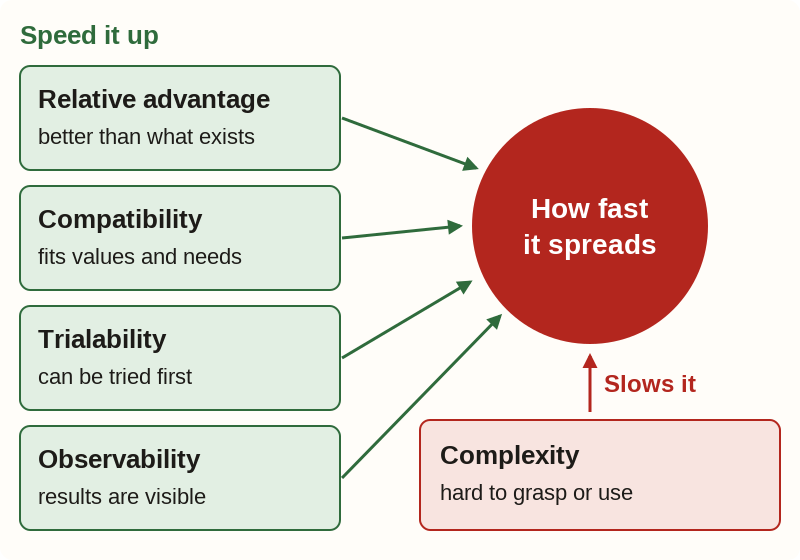
Explains how and how fast new ideas spread through a social system over time.
Helps with
- why is our new idea not catching on
- how fast will people adopt this
- why people resist adopting something new
- spreading a new idea through an organisation
Use it when
Judging why an innovation is or is not catching on.
The parts
- Relative advantage
- Compatibility
- Complexity
- Trialability
- Observability
Watch out
Has a pro-innovation bias: it assumes adoption is good and blames non-adopters for lagging.
Where it comes from
Rogers revised the book through five editions to 2003; the parts are his perceived attributes of an innovation as named in later editions (the 1962 list differed, e.g. divisibility for trialability), and his adopter categories (innovators to laggards) are the other well-known part.
Source: Rogers, E. M. Diffusion of Innovations. New York: Free Press of Glencoe, 1962 (opens in a new tab)