Platform Business Model
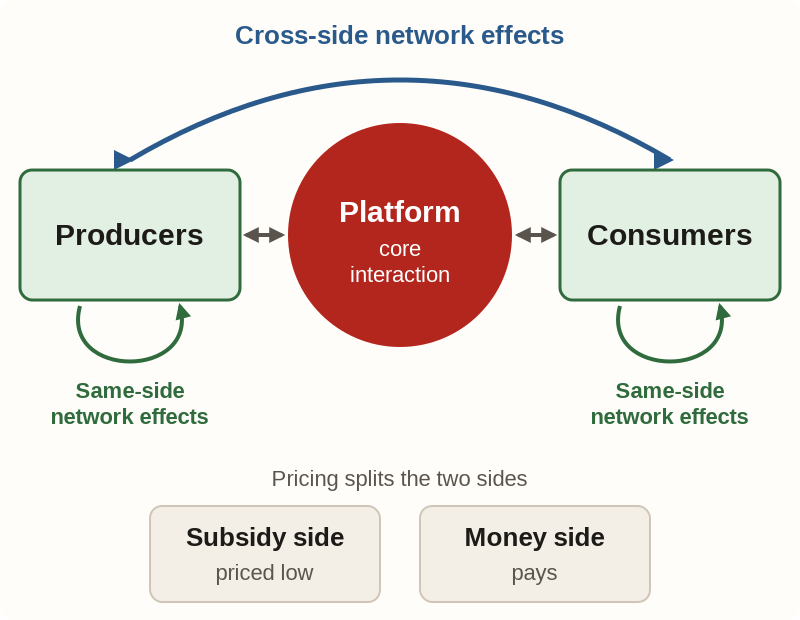
Creates value by connecting distinct user groups whose value to each other grows with network effects.
Helps with
- building a marketplace
- connecting buyers and sellers
- getting both sides of a marketplace on board
- which side of the market to subsidise
Use it when
Designing or judging a marketplace, network or ecosystem business.
The parts
- Producers
- Consumers
- Platform and its core interaction
- Cross-side network effects
- Same-side network effects
- Subsidy side and money side
Watch out
Network effects are easy to claim and hard to prove; many platforms never solve the chicken-and-egg start.
Where it comes from
Rochet and Tirole formalised two-sided markets in 2003 and Parker and Van Alstyne modelled two-sided network effects in 2005; the producer and consumer labels follow Parker, Van Alstyne and Choudary's Platform Revolution (2016).