Conjoint Analysis
Infers how much customers value each product feature and price from their choices between whole products.
Helps with
- which features do customers value most
- what will customers pay for each feature
- deciding which features to bundle together
- setting prices from customer trade-offs
Use it when
Setting prices or choosing which features to bundle into an offer.
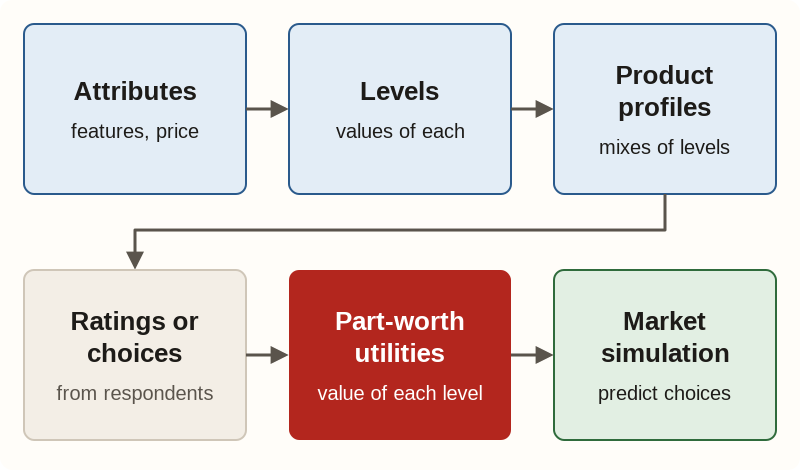
The parts
- Attributes
- Levels
- Product profiles
- Respondent ratings or choices
- Part-worth utilities
- Market simulation
Watch out
Results hold only for the attributes and levels tested, and survey choices can overstate what people will really pay.
Where it comes from
Green and Rao adapted conjoint measurement, a theory from mathematical psychology, to marketing problems.