Design Thinking
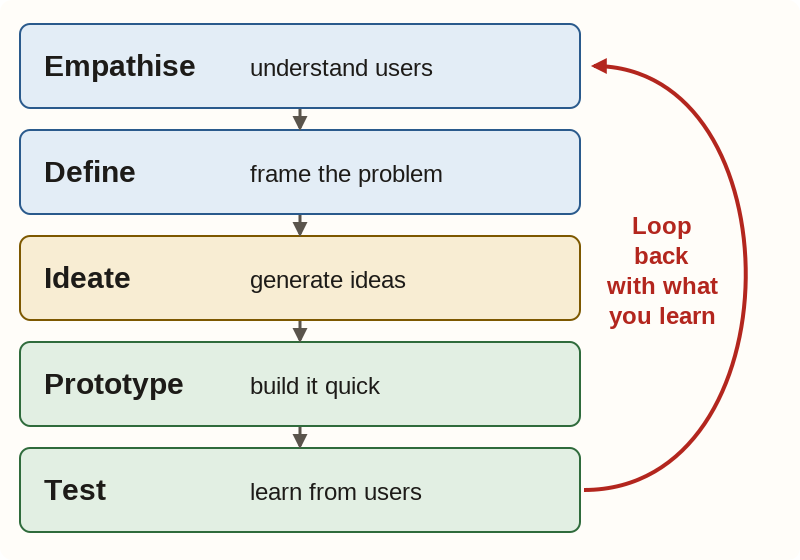
Solves problems by understanding users, reframing the problem and testing quick prototypes.
Helps with
- problem is vague and centred on users
- not sure what users really need
- understanding users before designing a solution
- testing quick prototypes with users
Use it when
Tackling an ill-defined problem centred on user needs.
The parts
- Empathise
- Define
- Ideate
- Prototype
- Test
Watch out
Run as a one-off workshop it produces sticky notes rather than tested, implemented solutions.
Where it comes from
The term has roots in design research from the 1960s onwards; Brown's article describes overlapping spaces of inspiration, ideation and implementation, while the five modes listed here are the Stanford d.school's (which spells the first 'Empathize').
Source: Brown, T. "Design Thinking", Harvard Business Review, June 2008 (opens in a new tab)