Stakeholder Theory
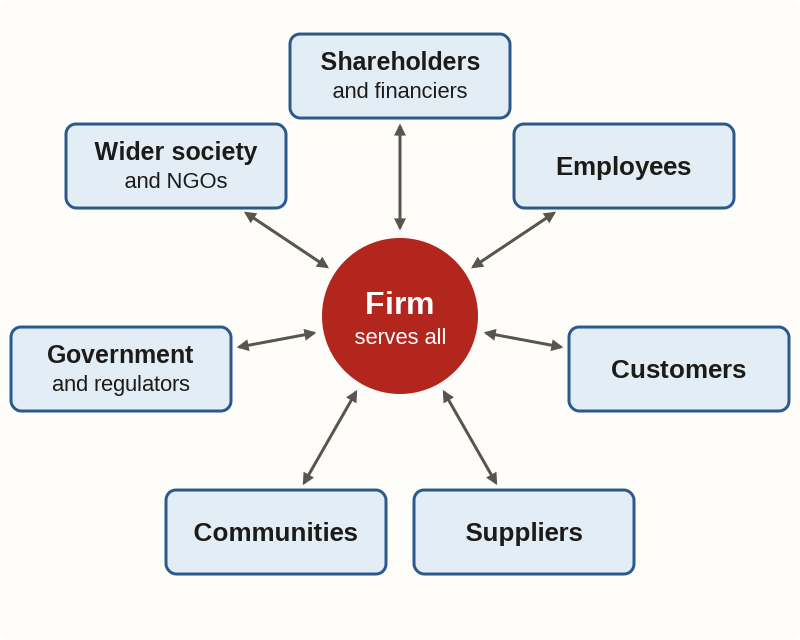
Treats a firm as serving everyone who can affect or is affected by it, not only shareholders.
Helps with
- whose interests should the strategy consider
- who is affected by our decisions
- communities and staff left out of decisions
Use it when
Deciding whose interests a strategy must account for.
The parts
- Shareholders and financiers
- Employees
- Customers
- Suppliers
- Communities
- Government and regulators
- Wider society and NGOs
Watch out
It gives no rule for trading off conflicting stakeholders, so it can be used to justify almost any decision.
Where it comes from
The groups shown are a common simplification; Freeman's 1984 stakeholder map lists more groups, and the theory sets no fixed list.