Agency Theory
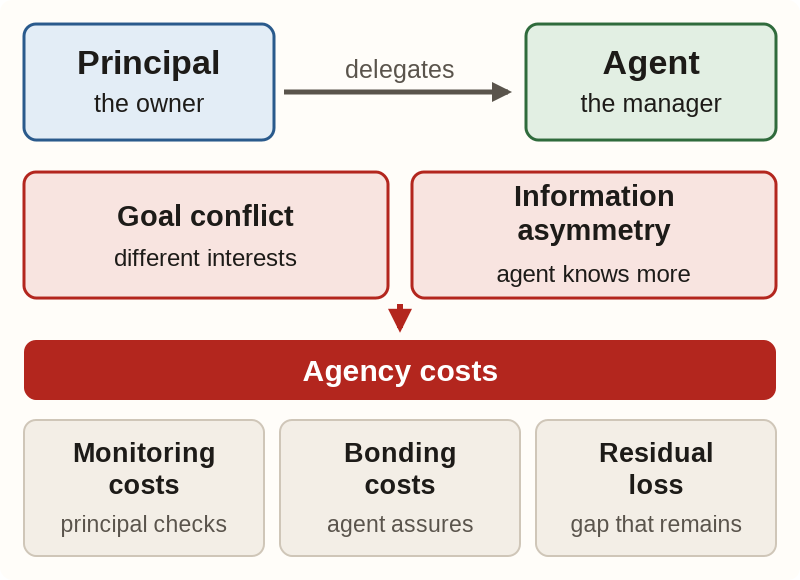
Explains the costs that arise when managers act for owners whose interests differ from theirs.
Helps with
- designing incentives for people we delegate to
- cannot see what our managers are doing
- owners and managers want different things
Use it when
Designing incentives, monitoring or governance for delegated decisions.
The parts
- Principal
- Agent
- Goal conflict
- Information asymmetry
- Monitoring costs
- Bonding costs
- Residual loss
Watch out
It assumes self-interested agents, and incentive schemes built on it can crowd out trust and invite gaming.
Where it comes from
Stephen Ross and Barry Mitnick both set out a theory of agency in 1973; Jensen and Meckling's 1976 paper defined agency costs and applied them to the firm.