Modigliani-Miller Theorem
Shows that, in perfect markets, how a firm is financed does not change what it is worth.
Helps with
- does taking on more debt create value
- does paying dividends change company value
- reasoning about debt versus equity funding
Use it when
Reasoning about whether a change in debt or payout really creates value.
The parts
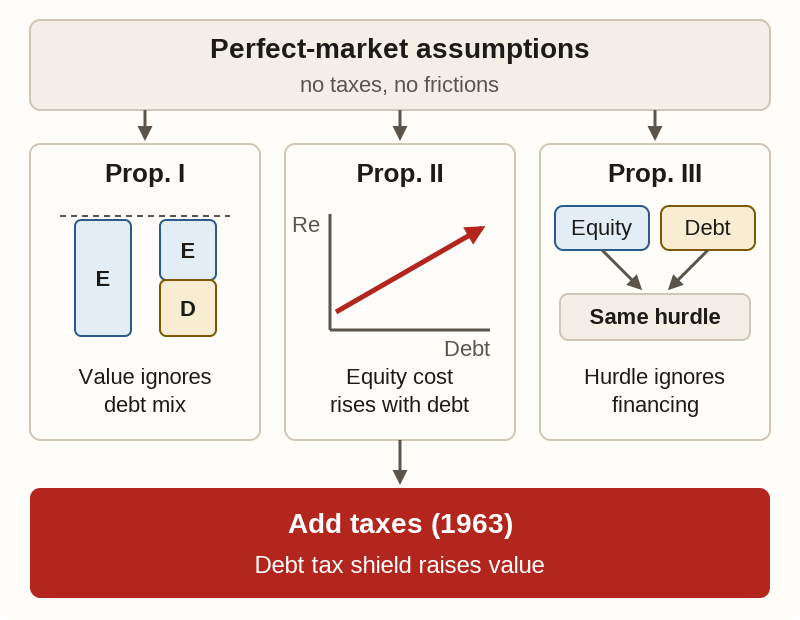
- Perfect-market assumptions
- Prop. I: value ignores debt mix
- Prop. II: equity cost rises with debt
- Prop. III: hurdle ignores financing
- Taxes: debt tax shield (1963)
Watch out
Real markets have taxes, bankruptcy costs and information gaps, so it shows where value comes from, not that financing never matters.
Where it comes from
Their 1963 correction showed that with corporate tax, debt's tax shield raises firm value; a 1961 paper applied the same logic to dividend policy.