Capital Asset Pricing Model (CAPM)
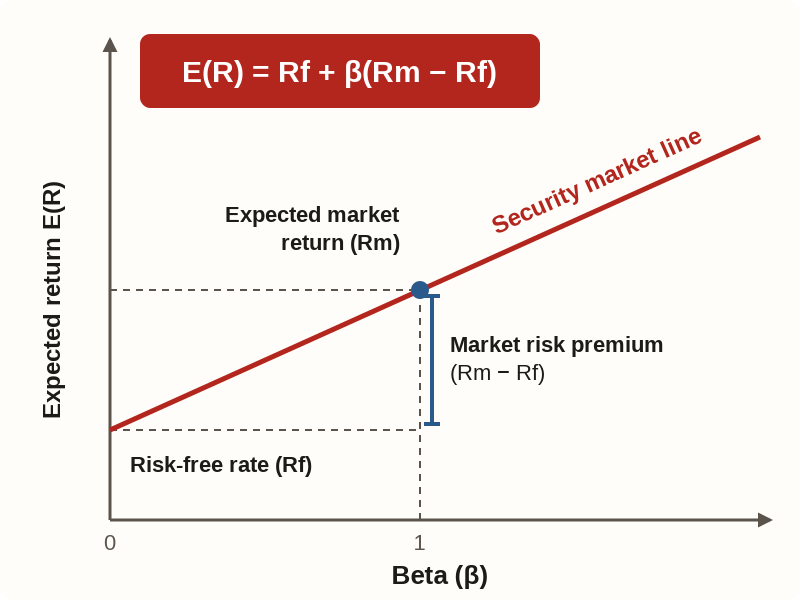
Prices an asset's expected return from the risk-free rate plus beta times the market risk premium.
Helps with
- what return should investors expect on a risky asset
- estimating the cost of equity
- how risky is a share versus the market
Use it when
Estimating a cost of equity or a required return on a risky asset.
The parts
- Risk-free rate (Rf)
- Beta (β)
- Expected market return (Rm)
- Market risk premium (Rm − Rf)
- E(R) = Rf + β(Rm − Rf)
- Security market line
Watch out
Beta alone explains returns poorly in tests, and the inputs (beta, premium) move a lot with the period chosen.
Where it comes from
Lintner (1965) and Mossin (1966) derived the model independently, and Jack Treynor wrote an unpublished version in the early 1960s.