Efficient Market Hypothesis
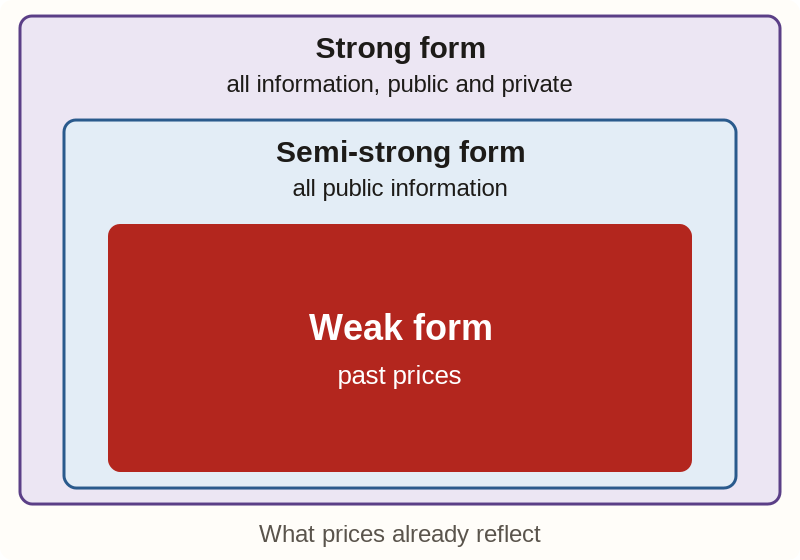
Holds that prices already reflect available information, so beating the market after costs is unlikely.
Helps with
- can anyone beat the market
- is a claimed market-beating strategy real
- do share prices already reflect the news
- whether stock picking is worth the fees
Use it when
Judging whether a trading or valuation edge is likely to be real.
The parts
- Weak form: past prices
- Semi-strong form: public information
- Strong form: all information
Watch out
Bubbles and persistent anomalies show prices can stray from value, and the hypothesis can only be tested jointly with a pricing model.
Where it comes from
Fama used 'efficient market' in his 1965 work on random walks; the 1970 review set out the weak, semi-strong and strong forms.