Weighted Average Cost of Capital (WACC)
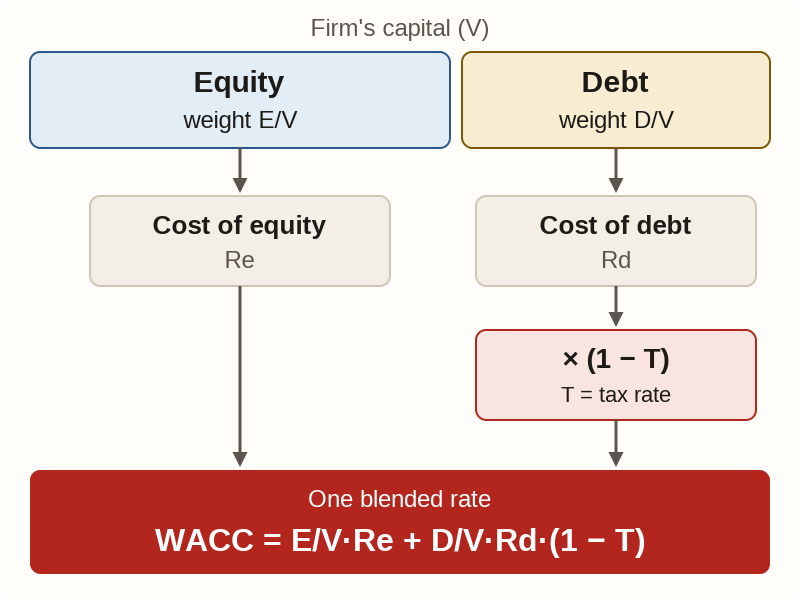
Blends the costs of equity and after-tax debt, weighted by their share of the firm's capital.
Helps with
- what discount rate to use for typical projects
- setting a hurdle rate for average-risk investments
- working out our blended cost of funding
Use it when
Setting the discount rate or hurdle rate for a firm's typical project.
The parts
- Cost of equity (Re)
- Cost of debt (Rd)
- Tax rate (T)
- Equity weight (E/V)
- Debt weight (D/V)
- WACC = E/V·Re + D/V·Rd·(1−T)
Watch out
It suits only projects as risky as the firm's average, and using book rather than market weights distorts it.
Where it comes from
The weighted formula has no single originator; Modigliani and Miller (1958) analysed a firm's average cost of capital and argued that, without taxes, it does not change with the debt-equity mix.