Scenario
Making an investment decision
A new site, a project or an acquisition is on the table. Test whether it makes money, what it is worth today and what could go wrong.
Say your board is weighing a new production line or the purchase of a smaller rival. The spreadsheet looks promising, but spreadsheets usually do. This guide checks whether the plan can make money at all, values it properly, sets a discount rate that matches its risk, accounts for the flexibility you would have later, and then stress-tests the whole case before anyone signs.
Can this make money at volumes we can realistically reach?
Start with a quick sense check. Break-Even (CVP) Analysis finds the sales volume at which revenue covers fixed and variable costs, and the margin of safety between that point and your forecast. If the plan only works at volumes well above anything you have achieved, you have learned that cheaply. It assumes straight-line costs, so use it as a first filter. If the plan passes, it is worth building a full valuation.
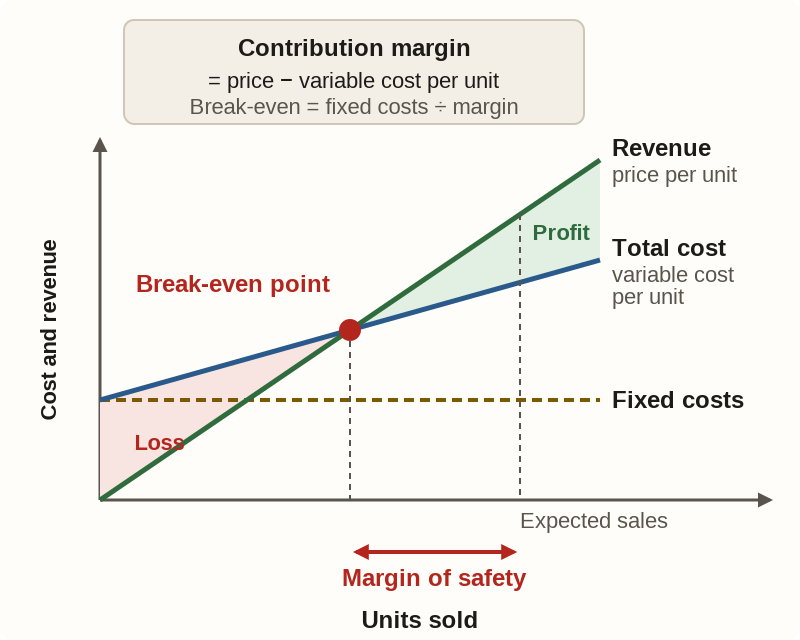
Break-Even (CVP) Analysis
Finds the sales volume at which revenue covers fixed and variable costs, and how profit moves around it.Read the framework →Is it worth more than it costs?
Discounted Cash Flow and NPV values the investment by forecasting its cash flows, discounting each one to today and subtracting what you pay. A positive net present value means it should earn more than your required return. Much of the value often sits in the terminal value, so look at how much rests on it. The result depends on a discount rate, which is the next question.
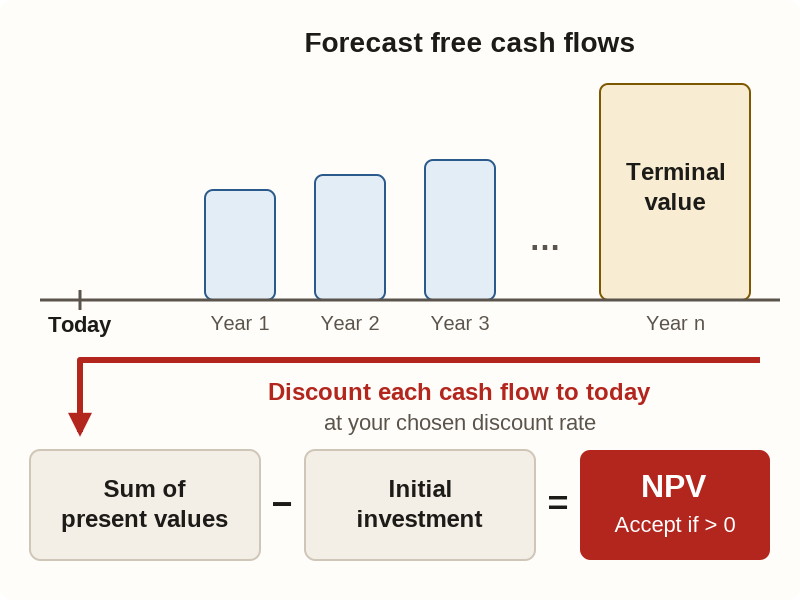
Discounted Cash Flow and NPV
Values an investment by discounting its expected future cash flows to today at a required rate.Read the framework →What return should we demand?
The Weighted Average Cost of Capital (WACC) blends what your equity and your after-tax debt cost, weighted by their share of your capital, using market values where you can. It is the right hurdle for a project about as risky as your business as a whole. If this investment is a step into something riskier, such as a new market, the firm-wide rate will flatter it.
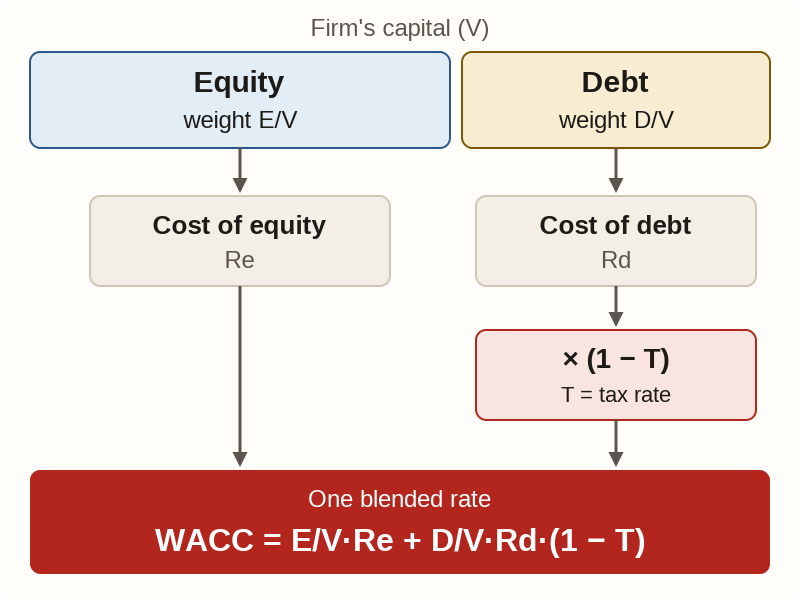
Weighted Average Cost of Capital (WACC)
Blends the costs of equity and after-tax debt, weighted by their share of the firm's capital.Read the framework →What return does this project's own risk call for?
The Capital Asset Pricing Model (CAPM) estimates the return equity investors require from the risk-free rate plus beta times the market risk premium. It supplies the cost of equity inside your WACC, and you can use the beta of firms already in the target activity, adjusted for your own debt level, to build a discount rate that matches this project's risk rather than yours that matches this project's risk rather than yours. The inputs move with the period you choose, so test a range.
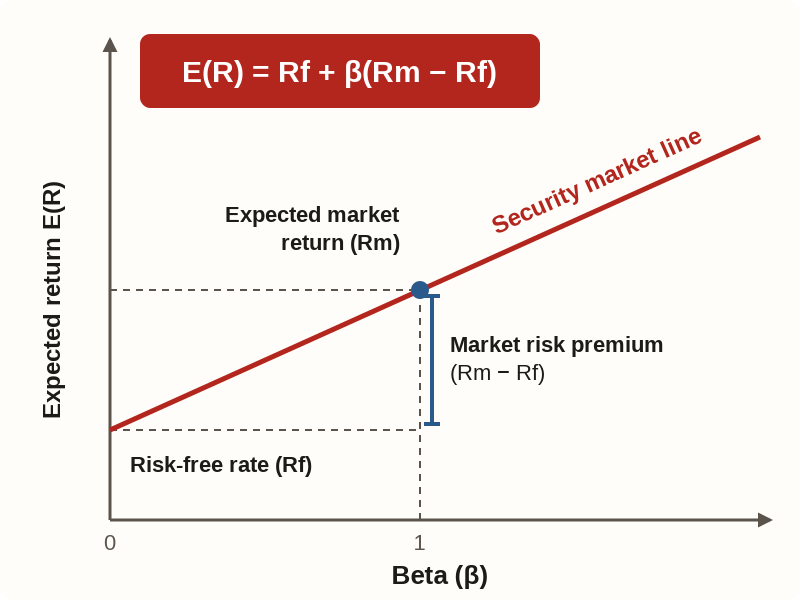
Capital Asset Pricing Model (CAPM)
Prices an asset's expected return from the risk-free rate plus beta times the market risk premium.Read the framework →What is it worth to keep our options open?
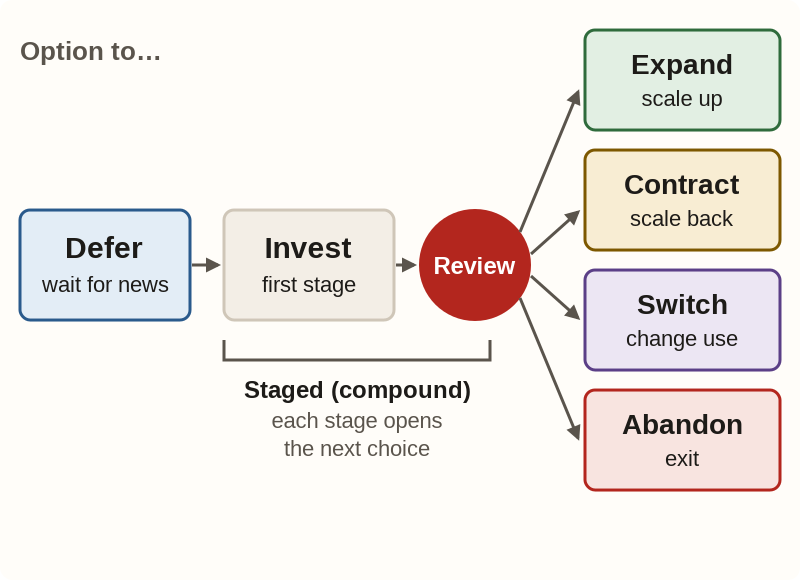
A plain NPV assumes you commit everything now and then sit still. In practice you might start small and expand, pause, or walk away if early results disappoint. Real Options puts a value on that flexibility, and it can turn a marginal project into a sensible staged one. Be wary when the option value is what makes the case work, because its inputs are hard to estimate and easy to stretch.
Real Options
Values the flexibility to delay, expand, scale back or abandon an investment as options.Read the framework →If this fails, what will the reason have been?
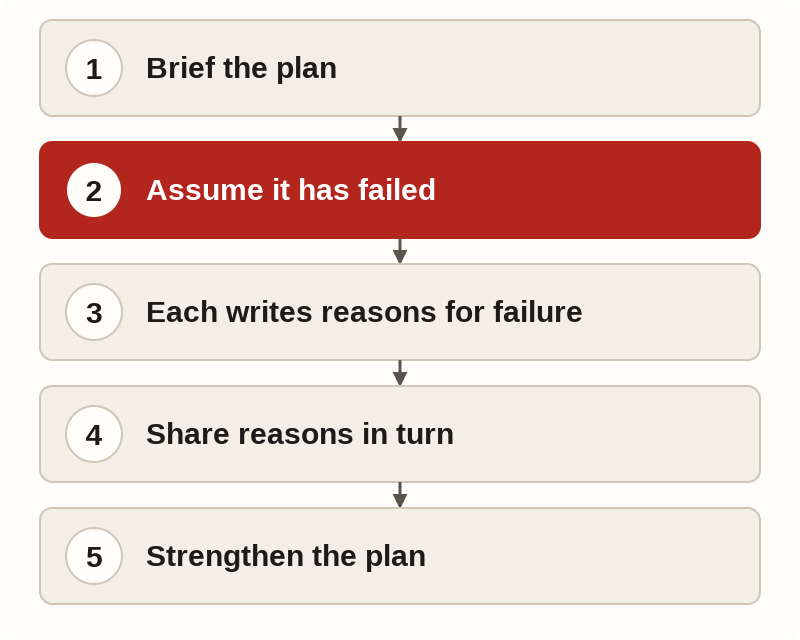
Before you commit, gather the team and run a Pre-Mortem: assume it is two years on and the investment has failed, and ask each person to write down why. People who would not challenge the plan in a meeting will often name the risk everyone has privately noticed. Give each serious risk an owner and a response, and feed the worst ones back into your forecasts.
Pre-Mortem
Imagines a plan has already failed so the team can name the reasons before it starts.Read the framework →
Read next
Making a hard decision
The options are unclear, the stakes are high and people disagree. Frame the decision, settle who decides and test the choice.
Writing a recommendation
The analysis is done and someone senior needs a decision. Structure the problem and write a recommendation they can act on.
Managing an innovation portfolio
You have more ideas than money and a core business that wants it all. Balance your innovation bets, plan them and prune them.