Gordon Growth Model
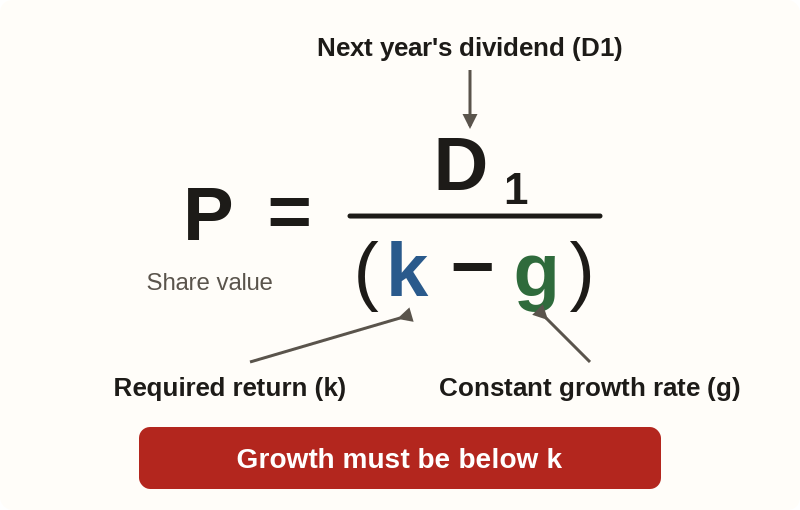
Values a share as next year's dividend divided by the required return minus a constant growth rate.
Helps with
- valuing a mature dividend-paying company
- what is a share worth from its dividends
- estimating a terminal value
Use it when
Valuing a mature, dividend-paying firm or a terminal value.
The parts
- Next year's dividend (D1)
- Required return (k)
- Constant growth rate (g)
- Growth must be below k
- P = D1 / (k − g)
Watch out
The price is very sensitive to g, and the model breaks down when growth is not steady or comes near the required return.
Where it comes from
It applies John Burr Williams's 1938 dividend discount approach to dividends growing at a constant rate.