Scenario
Setting up governance, risk and control
The board wants proof that risks are owned and controls work. Set up governance that satisfies it without stopping managers acting.
Say you are the chief operating officer of a growing services firm that has just taken outside investment. The new board asks who owns which risks, how you know controls are working, and how management decisions are kept in line with investors' interests. Until now, control has meant the founder checking everything. You need something that scales, satisfies the board and still lets managers act.
Where could management and owners want different things?
Start with why governance is needed at all. Agency Theory looks at what happens when owners delegate decisions to managers whose interests and information differ from theirs. List the decisions where that gap matters most for your firm: large contracts, pricing discounts, hiring, spending against budget, and how results are reported. For each, ask what the board cannot see and what a manager might be tempted to do. This list of exposed decisions is what the rest of the structure has to cover.
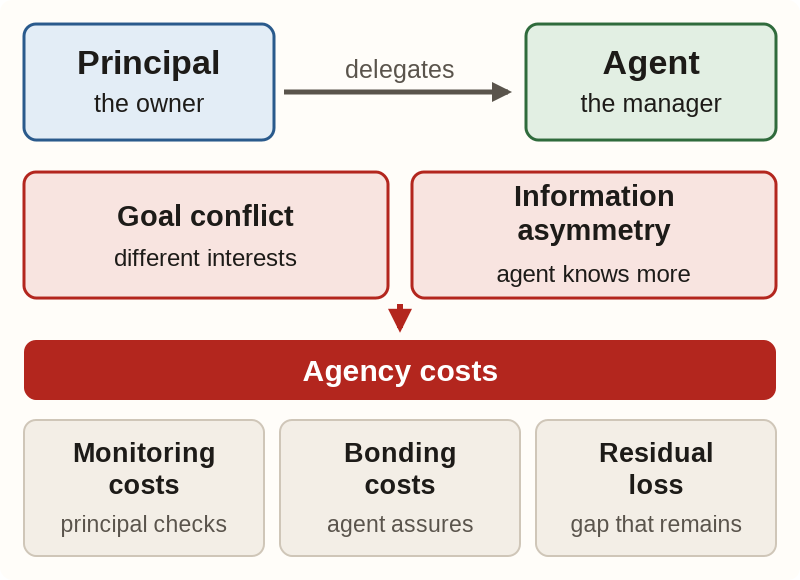
Agency Theory
Explains the costs that arise when managers act for owners whose interests differ from theirs.Read the framework →Who owns each risk, and who checks?
With the risks listed, assign roles. The Three Lines Model separates the managers who own and manage risk day to day, the specialist roles that set policy and oversee it, such as finance or compliance, and internal audit, which gives the board independent assurance. In a firm your size one person may cover more than one role, which is acceptable as long as nobody marks their own homework on the same risk. The result is a short table of risks, owners and reviewers that the next step fills with controls.
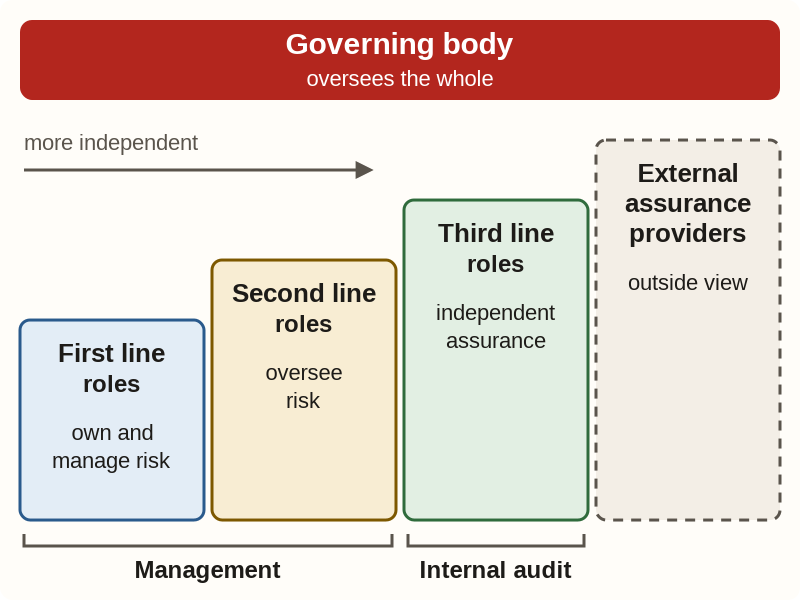
Three Lines Model
Sets out who owns risk, who oversees it and who gives independent assurance.Read the framework →Are our controls well designed, and do they work?
Now check the controls themselves. The COSO Internal Control Framework looks at five components: the control environment and tone from the top, risk assessment, the control activities themselves, information and communication, and ongoing monitoring. Walk each exposed decision from the first step through those five and note where a component is missing, such as approval limits that exist on paper but are never reviewed. Fix the gaps that matter, test a sample of controls in practice, and report the results to the board.
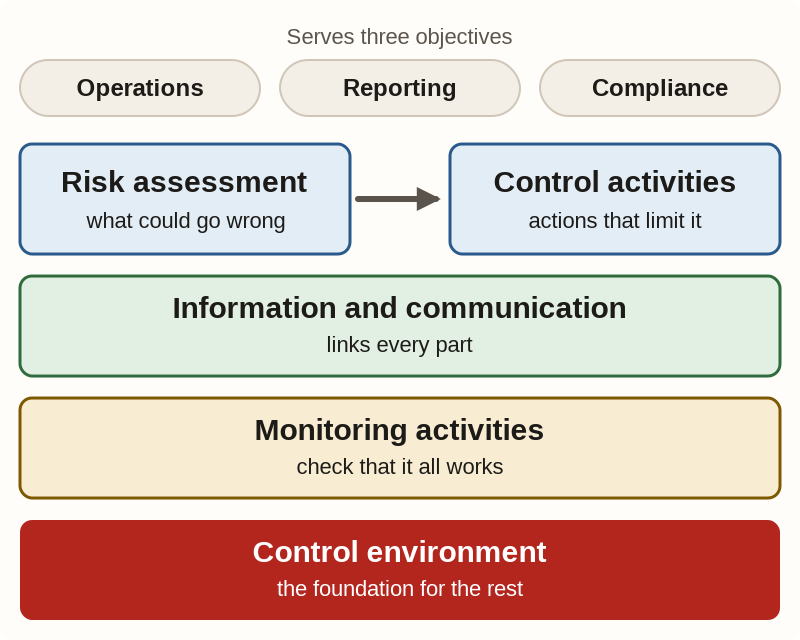
COSO Internal Control Framework
Defines internal control through five components applied to operations, reporting and compliance.Read the framework →Are we controlling so tightly that nobody takes initiative?
The risk at this point is building a system that only says no. Simons' Levers of Control balances four kinds of system: beliefs that tell people what the firm is for, boundaries that mark what is off limits, diagnostic measures that track results, and interactive conversations where leaders debate the uncertainties that worry them. Most of what you built so far is boundaries and diagnostics. Check that the purpose is clear and that leaders hold regular, open discussions about strategic risk, so managers know where they are free to act.
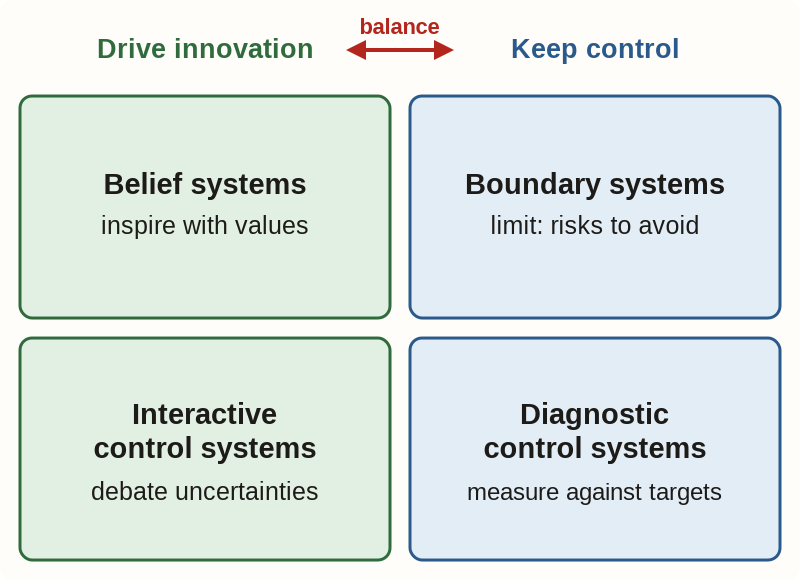
Simons' Levers of Control
Balances innovation and control through four systems that inspire, limit, measure and debate.Read the framework →
Read next
Building a sustainability and ESG plan
Customers, lenders and staff are asking about your social and environmental impact. Build an answer you can measure and defend.
Making a hard decision
The options are unclear, the stakes are high and people disagree. Frame the decision, settle who decides and test the choice.
Fixing a broken process
Work is slow, errors keep returning and the workarounds have workarounds. See the whole flow, find the causes and keep them fixed.