Scenario
Building a sustainability and ESG plan
Customers, lenders and staff are asking about your social and environmental impact. Build an answer you can measure and defend.
Say you lead a mid-sized logistics firm. A large customer has sent a supplier questionnaire on emissions, a lender wants an ESG section in the annual report, and staff keep asking what the company stands for. There is goodwill but no plan. This guide takes you from deciding who you answer to, through measuring what matters, to targets and the places where the work can pay its way.
Whose interests do we have to account for?
Begin by listing everyone who affects the business or is affected by it: shareholders and lenders, employees, customers, suppliers, the communities near your depots, regulators and campaign groups. Stakeholder Theory asks you to treat these as people the business serves, not as noise around the shareholders. For each group, note what they expect and what power they have over you. The list will not tell you how to trade one group off against another, but it tells you whose questions your sustainability work must be able to answer.
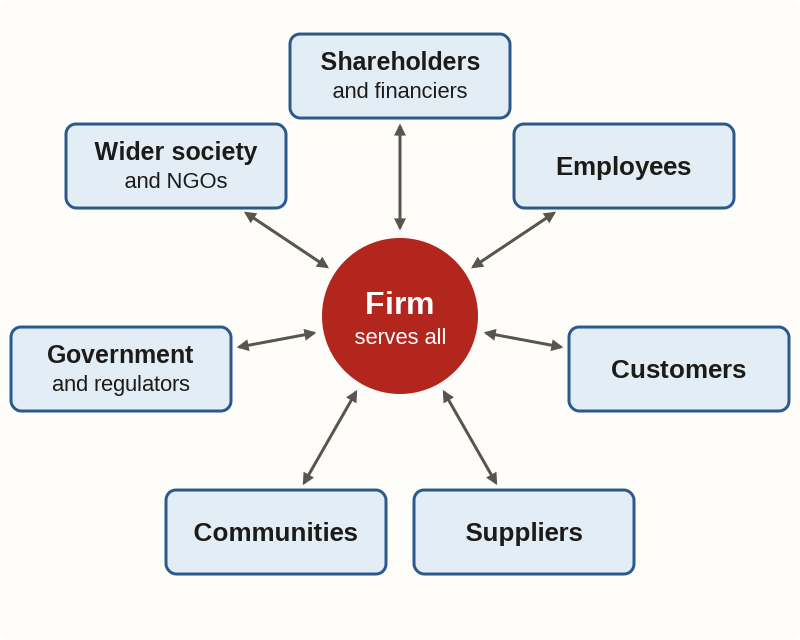
Stakeholder Theory
Treats a firm as serving everyone who can affect or is affected by it, not only shareholders.Read the framework →What do we owe them before anything optional?
Next, sort the expectations by how firm they are. Carroll's CSR Pyramid separates economic responsibilities (stay viable), legal ones (comply), ethical ones (do what is right where the law is silent) and philanthropic ones (give back). This stops the conversation jumping straight to sponsorships while a legal or ethical gap sits unaddressed. Treat the layers as a checklist rather than a strict order of priority. The gaps you find become candidates for what you measure in the next step.
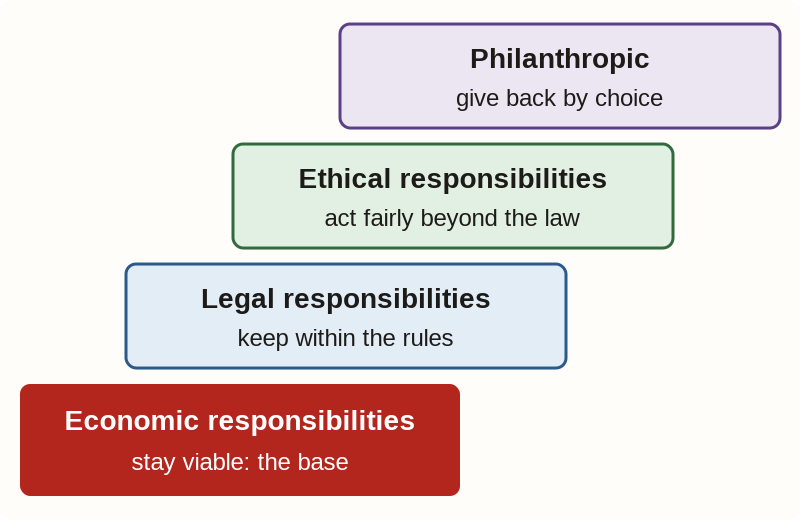
Carroll's CSR Pyramid
Stacks a firm's responsibilities from economic and legal up to ethical and philanthropic.Read the framework →What should we measure and report beyond profit?
Now decide what to report. The Triple Bottom Line asks you to judge results in three lines: economic, social and environmental. Pick a few measures under each that link to the expectations and gaps you found, such as staff turnover and safety incidents under social, and energy use and waste under environmental. Keep the lines separate rather than combining them into one score, since a good year for profit does not cancel a bad year for safety. The environmental line usually needs a proper carbon inventory, which is the next step.
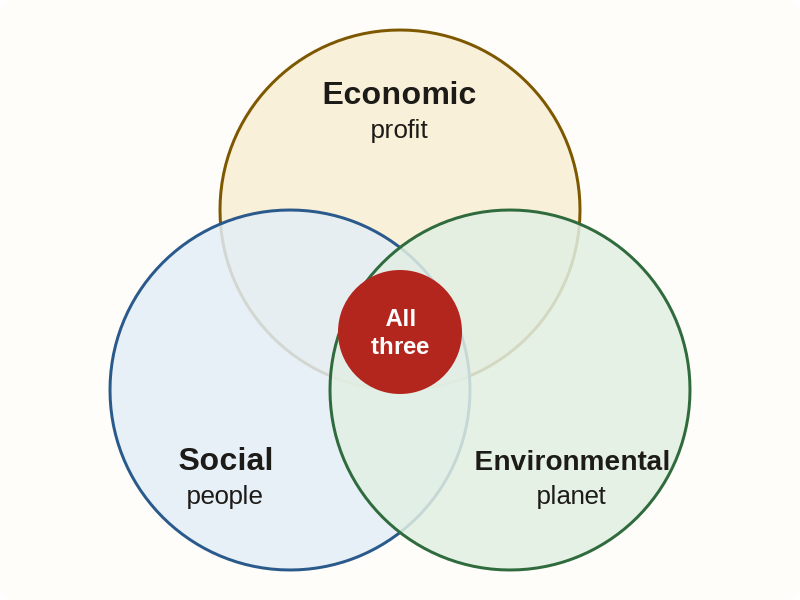
Triple Bottom Line
Judges a business on its social and environmental results as well as its profit.Read the framework →Where do our emissions come from?
For a logistics firm, emissions are likely to be the first thing customers and lenders ask about. The GHG Protocol Scopes sort them into direct emissions from fuel you burn, emissions from the energy you buy, and everything else in the value chain, from subcontracted hauliers to the goods you purchase. Build the inventory in that order, from the data you control to the data you must estimate, and be open about which figures are estimates. This baseline is what any target in the next step will be measured against.
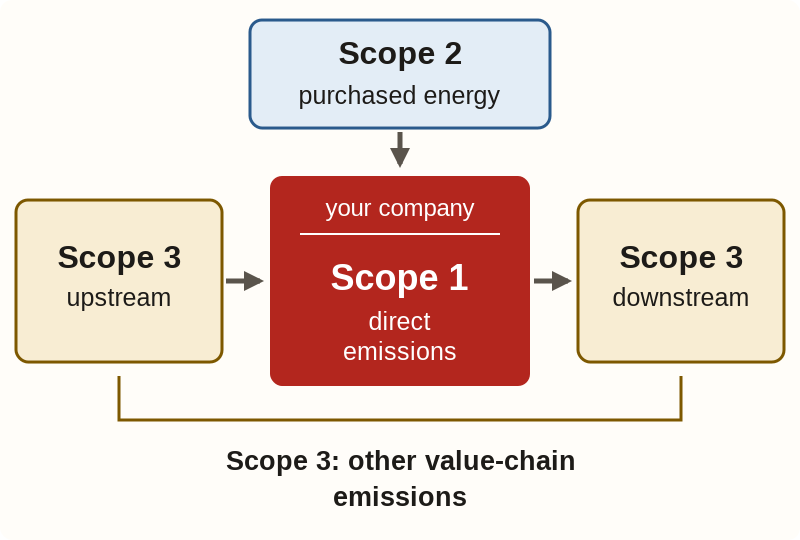
GHG Protocol Scopes 1, 2 and 3
Sorts a company's greenhouse gas emissions into direct, purchased-energy and value-chain scopes.Read the framework →What would a responsible target look like?
Targets are easy to set too low or too vaguely. Doughnut Economics frames the goal as staying above a social foundation, such as fair pay and safe work, and below an ecological ceiling, such as a fair share of what the planet can absorb. It will not hand you numbers, but it helps you test whether a proposed target is moving you towards that space or just improving on last year. Use it to set direction, then turn that direction into dated targets against your baseline.
Doughnut Economics
Defines a safe and just space between a social foundation and an ecological ceiling.Read the framework →Where can this work strengthen the business itself?
Last, look for places where meeting a social or environmental need also improves the business. Creating Shared Value suggests three routes: new products and markets, a more productive value chain, and stronger local suppliers and skills. For you that might mean a low-emission delivery service customers will pay for, or route planning that cuts both fuel and cost. Be honest that not every goal will pay back; the earlier steps exist so that the unprofitable responsibilities still get done.
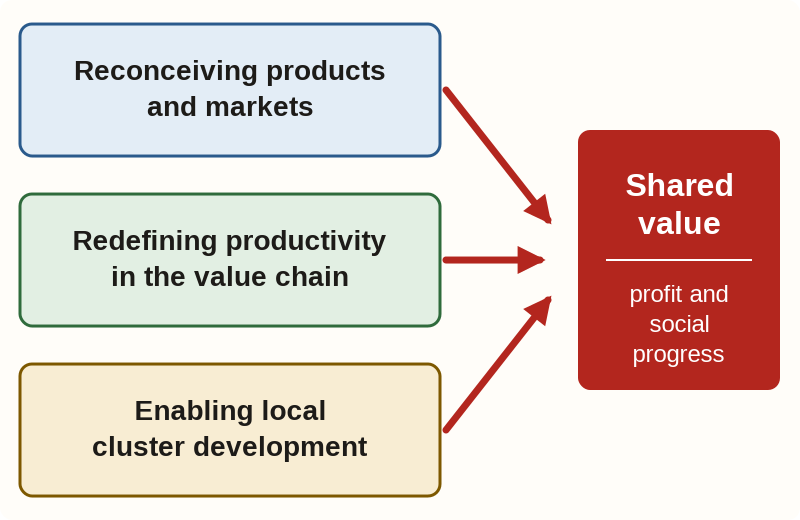
Creating Shared Value
Looks for profit in solving social problems rather than treating them as costs or charity.Read the framework →
Read next
Setting the annual strategy
It's planning season and you need a strategy, not a wish list. Go from an honest diagnosis to goals each team can act on.
Setting up governance, risk and control
The board wants proof that risks are owned and controls work. Set up governance that satisfies it without stopping managers acting.
Writing a recommendation
The analysis is done and someone senior needs a decision. Structure the problem and write a recommendation they can act on.