Scenario
Setting the annual strategy
It's planning season and you need a strategy, not a wish list. Go from an honest diagnosis to goals each team can act on.
Each year the leadership team gathers to set direction, and each year it is tempting to roll last year's plan forward with bigger numbers. This guide gives the planning cycle a shape. You start with an honest view of where you stand, make real choices, test them, show how they connect, decide how to measure them, and finish with goals each team can own for the next quarter.
Where do we stand right now?
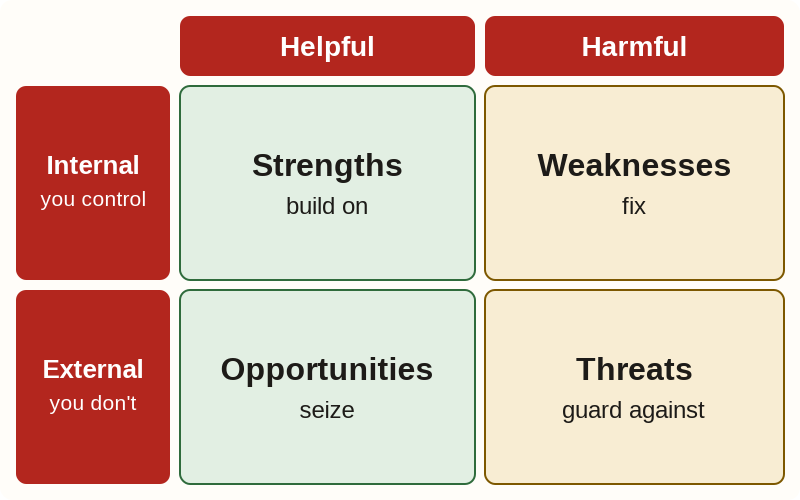
Open with a SWOT Analysis to get the facts on the table: internal strengths and weaknesses, external opportunities and threats. Keep it short and evidence-based, and push each item to say why it matters. Then pick the few items that most affect the year ahead; a long, unranked list helps nobody. Those priorities are the raw material for the choices in the next step.
SWOT Analysis
Sorts internal and external factors into strengths, weaknesses, opportunities and threats.Read the framework →What are we choosing to do, and not do?
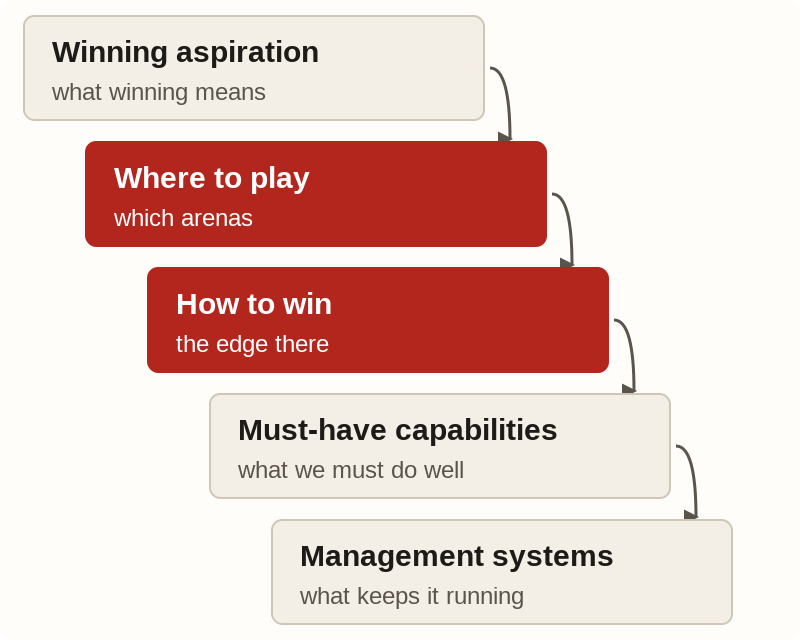
Playing to Win turns that picture into linked choices: what winning looks like, where to play, how to win there, which capabilities you must have, and what management systems support them. The test of each answer is what it rules out. If where to play still includes every customer and region you serve today, you have not chosen. Draft two or three distinct options before settling on one, so the team compares real alternatives.
Playing to Win
Links five strategic choices, from winning aspiration to management systems, into one cascade.Read the framework →Is this a strategy or a list of goals?
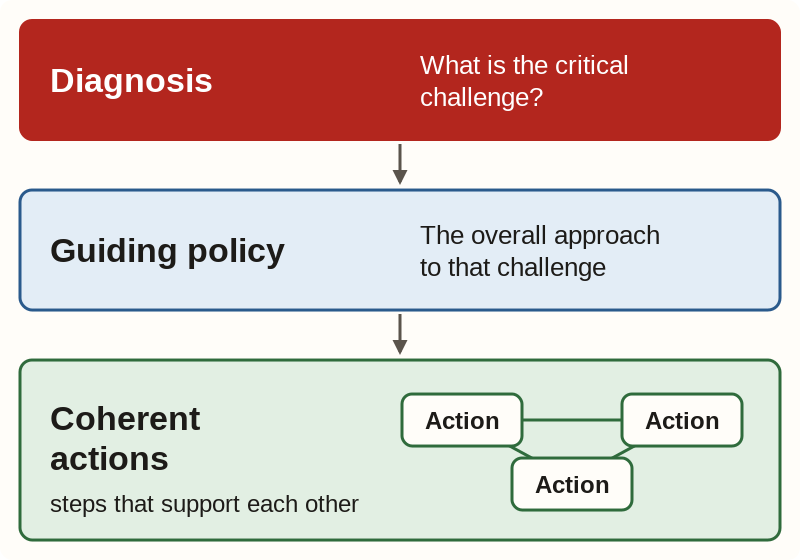
Before cascading anything, test the draft with the Kernel of Good Strategy. Does it contain a clear diagnosis of the main challenge, a guiding policy for dealing with it, and actions that reinforce each other? Many plans skip the diagnosis and jump to targets. If you cannot state the challenge in a sentence or two, return to the SWOT priorities. A strategy that passes this test is ready to be mapped.
Kernel of Good Strategy
Tests a strategy for a clear diagnosis, a guiding policy and coherent actions.Read the framework →How do our objectives connect?
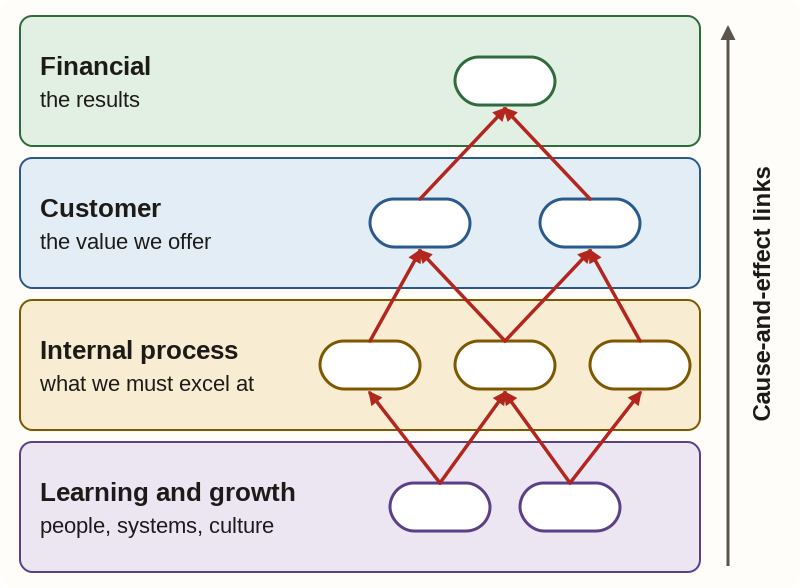
A Strategy Map draws the strategy as cause and effect across financial, customer, internal process, and learning and growth objectives. It shows, for example, how building a new skill leads to a better process, which wins a customer outcome, which drives revenue. Each arrow is an assumption, so mark the ones you have evidence for and the ones you are betting on. The map tells you what to measure next.
Strategy Map
Draws a strategy as cause-and-effect links between objectives across the four scorecard perspectives.Read the framework →How will we know it's working?
The Balanced Scorecard attaches measures and targets to the objectives on your map, so performance is tracked beyond the financials. Choose one or two measures per objective, including leading indicators that move before results do. If a measure cannot be traced back to an objective on the map, drop it. The scorecard becomes the yearly view the leadership team reviews; the next step turns it into quarterly work.
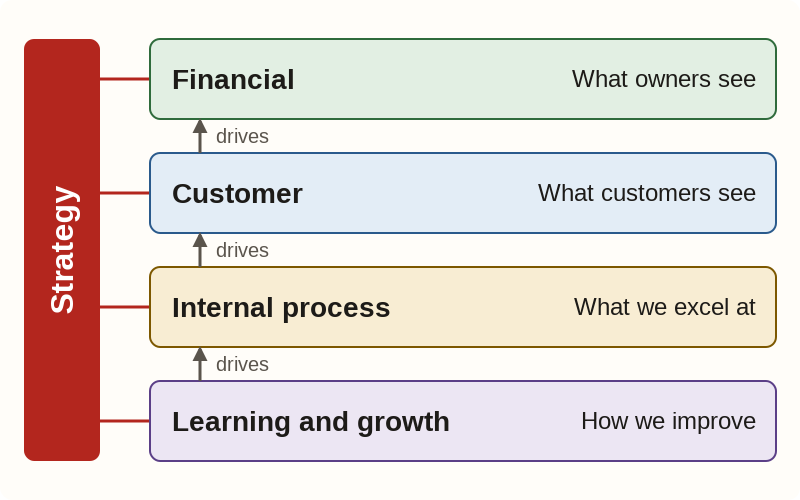
Balanced Scorecard
Tracks performance beyond financials across four perspectives.Read the framework →What will each team do this quarter?
OKRs translate the yearly scorecard into a few objectives with measurable key results for each team and quarter. Teams draft their own, linked to the strategy, and leadership checks that together they cover what matters. Keep the number small. Review them openly, learn from misses, and keep them separate from pay, or people will set targets they know they can hit.
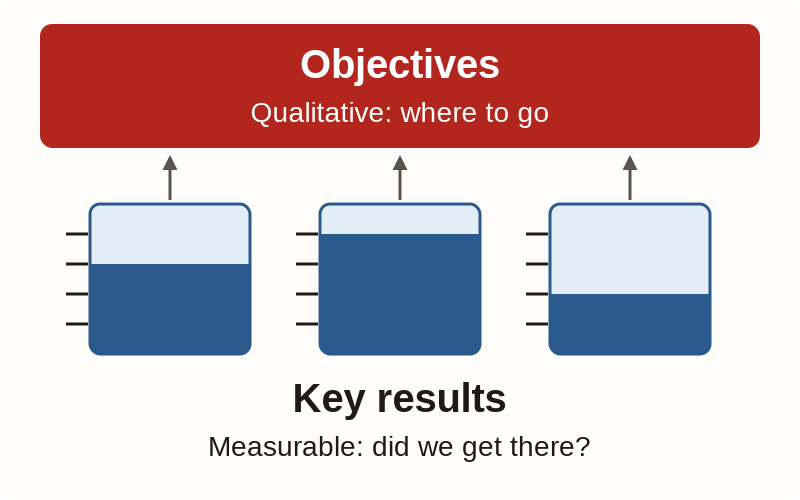
OKRs
Pairs a qualitative objective with measurable key results.Read the framework →
Read next
Entering a new market
You are weighing a move into a market you don't serve yet. Decide whether to go, how far to commit at first and which customers to win.
Leading a change programme
You have to move an organisation from the old way of working to a new one. Plan the change and bring people with you.
Responding to a competitor
A rival has made a move and your team wants to react. Read the rival, test your own position, then choose a response.