Scenario
Leading a change programme
You have to move an organisation from the old way of working to a new one. Plan the change and bring people with you.
Say you have been asked to move a 300-person business onto a new operating model: new systems, new reporting lines and new ways of working. The plan on paper is the easy part. The hard part is that people have to stop doing what they know and start doing something they do not yet trust. These steps cover the overall shape of the change, who you need on side, the plan itself, and how individuals get through it.
What does this change ask of people?
Begin with the simple shape in Lewin's Change Model: something has to be unfrozen, changed and then settled again. Ask what habits, beliefs or structures must loosen before anything new can take hold, and what will hold the new way in place afterwards. It is a blunt tool and fits poorly if the organisation is changing continuously, but it is a clear way to explain to a team why the first phase is not about new systems at all. Carry forward a list of what has to unfreeze.
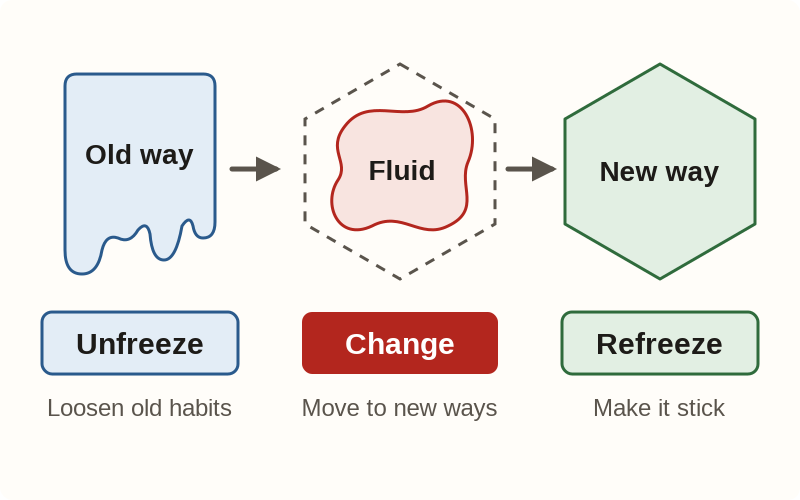
Lewin's Change Model
Describes change as unfreezing, changing and refreezing.Read the framework →Whose support do we need, and how much?
Before you write a plan, map the people who can shape the outcome on a Power-Interest Grid. Senior sponsors and union or works representatives may need managing closely; heads of unaffected functions may only need keeping satisfied. Look hard for anyone quiet but powerful, and redraw the grid as the programme moves, because positions shift. This map tells you who belongs in the guiding group in the next step and who needs which messages.
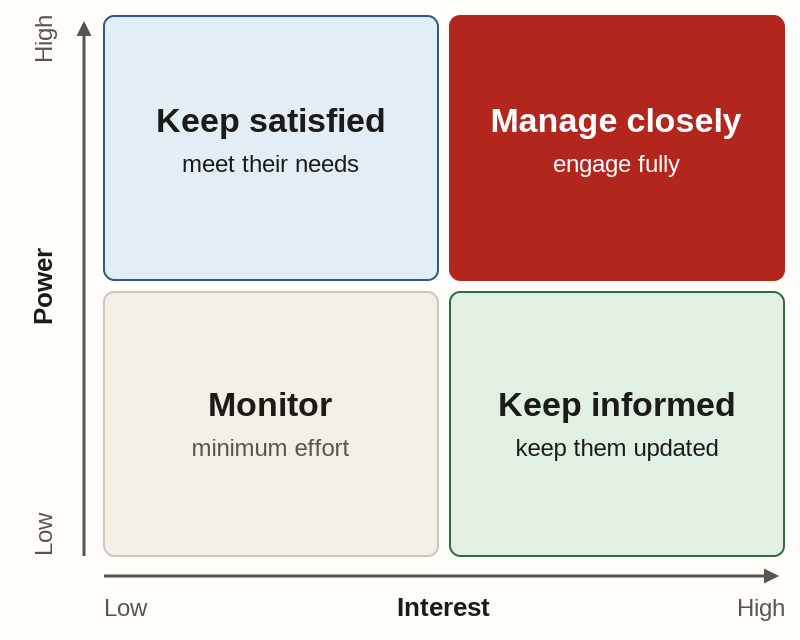
Power-Interest Grid
Maps stakeholders by their power and interest to decide how closely to engage each one.Read the framework →How do we sequence the programme?
With your stakeholders in view, Kotter's 8-Step Change Model gives you a running order: build a case for urgency, form a coalition from the people your grid flagged, set a vision, communicate it, clear obstacles, plan early wins, then build on those wins and anchor the new ways in the culture. It suits a planned, leader-driven change like this one. If parts of the change are genuinely uncertain, leave room to experiment rather than forcing every step. The plan you produce here sets out what happens; the next two steps deal with how people experience it.
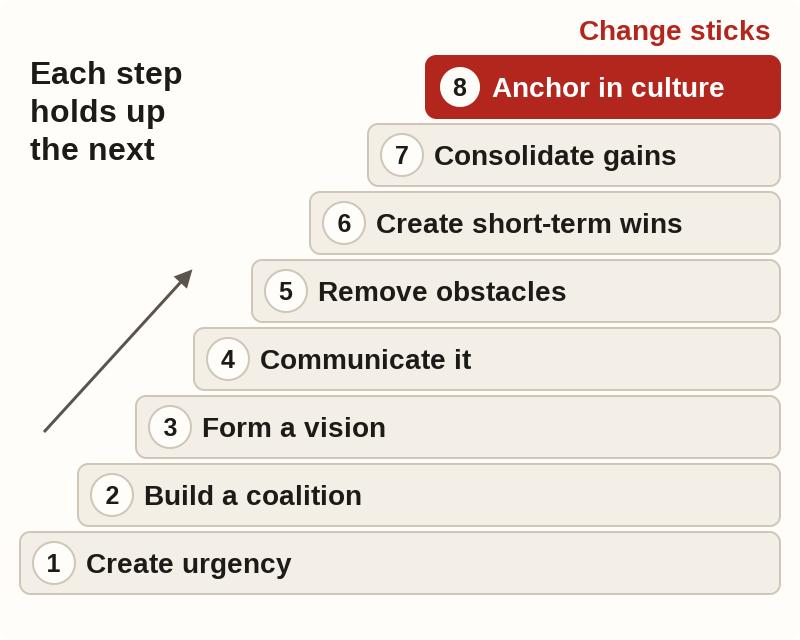
Kotter's 8-Step Change Model
Sequences the steps leaders take to make change stick.Read the framework →What are people losing, and how do we help them let go?
A new structure can go live on a set date while people are still attached to the old one. Bridges' Transition Model separates the change from the transition. Name openly what is ending, such as familiar teams, status or ways of working, and plan for the neutral zone where the old way has gone and the new one does not yet feel real. That in-between period is where confusion and quiet resistance tend to show up, so give it attention rather than hoping it passes.
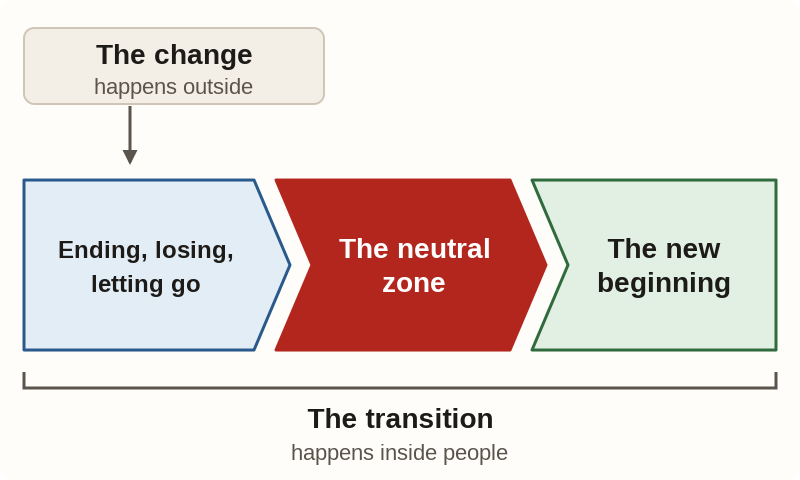
Bridges' Transition Model
Separates the external change from the inner transition people go through to accept it.Read the framework →How are people likely to react, and when?
The Change Curve helps you anticipate the emotional dip that often follows an unwelcome change, so you can time support and communication rather than being caught out by anger or low morale. Use it loosely: people do not move through the stages in a fixed order, and a dip is not proof that objections are only emotional. Some objections will be right. Listen for those, because they feed straight into the last step.
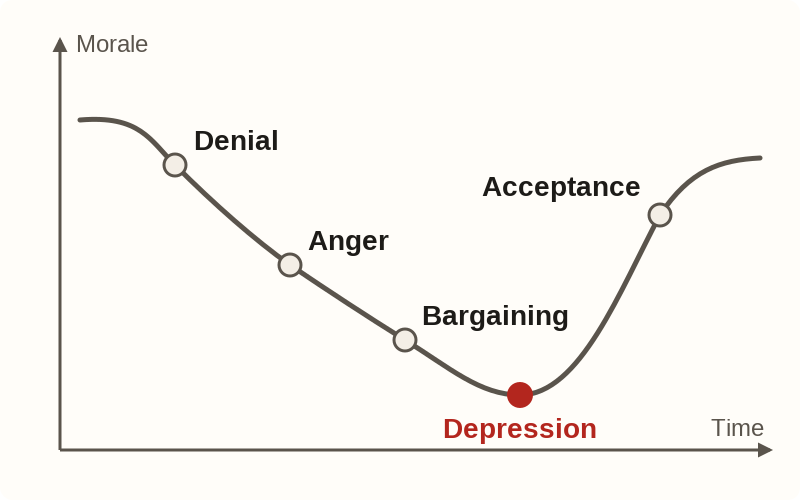
Change Curve
Maps the emotional dip and recovery people typically go through when a change is imposed on them.Read the framework →Why are some people still not adopting the change?
Months in, adoption will be uneven. ADKAR lets you diagnose individuals or teams who are stuck: do they know why the change is happening, do they want it, do they know how, can they do it, and is anything reinforcing it? Each gap calls for a different response, from clearer reasons to training to removing a system that still rewards the old way. If many people stall at the same point, the cause is probably structural, not personal.
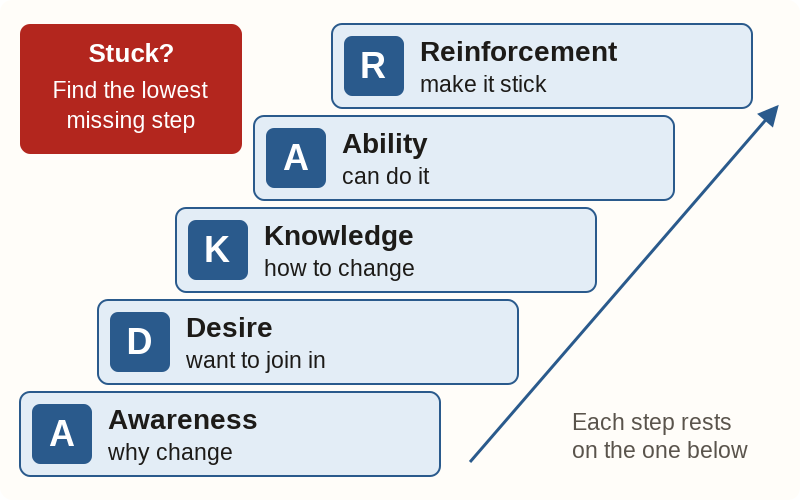
ADKAR
Models change at the individual level as five outcomes.Read the framework →
Read next
Reorganising the business
You need to change how the business is organised, and a new org chart will not do it alone. Diagnose, design and land the change.
Fixing a broken process
Work is slow, errors keep returning and the workarounds have workarounds. See the whole flow, find the causes and keep them fixed.
A team that isn't working
Deadlines slip, meetings go quiet and the same arguments keep coming back. Find out why, then decide what to change first.