Scenario
Reorganising the business
You need to change how the business is organised, and a new org chart will not do it alone. Diagnose, design and land the change.
Say you run a 450-person company that grew by adding teams as each new product arrived. Decisions are slow, customers deal with three departments for one problem, and nobody is sure who owns what. A reorganisation is on the table. The temptation is to move boxes on the chart and announce it.
What is going wrong, and where?
Begin with a broad diagnosis before anyone proposes a structure. Weisbord's Six-Box Model looks at purposes, structure, relationships, rewards, leadership and helpful mechanisms, and at each in its formal and informal form. Interview a cross-section of staff and sort what you hear into the boxes. You may find that the problem lies less in structure than in unclear purpose or rewards that pull teams apart. Carry the boxes that show the most strain into the next steps; they tell you what the reorganisation must fix.
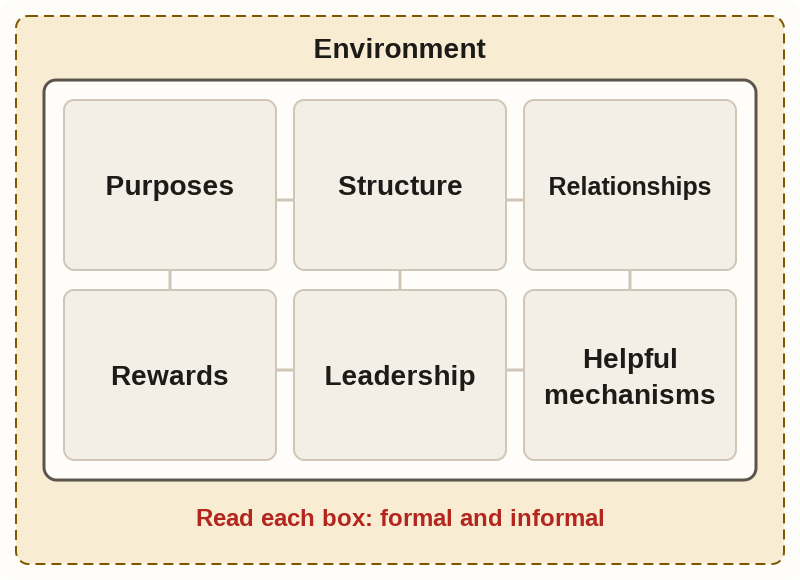
Weisbord's Six-Box Model
Diagnoses an organisation by looking at six linked areas, each in its formal and informal form.Read the framework →What culture do we have, and what do we need?
Structures sit inside a culture, and a new chart that fights the culture rarely lasts. The Competing Values Framework profiles an organisation along two tensions, flexibility against control and internal against external focus. Ask leaders and staff to profile the culture as it is and as it needs to be for the strategy. A company that grew product by product might, for example, score high on internal values and low on external focus. The gap between the two profiles shapes the design choices in the next step.
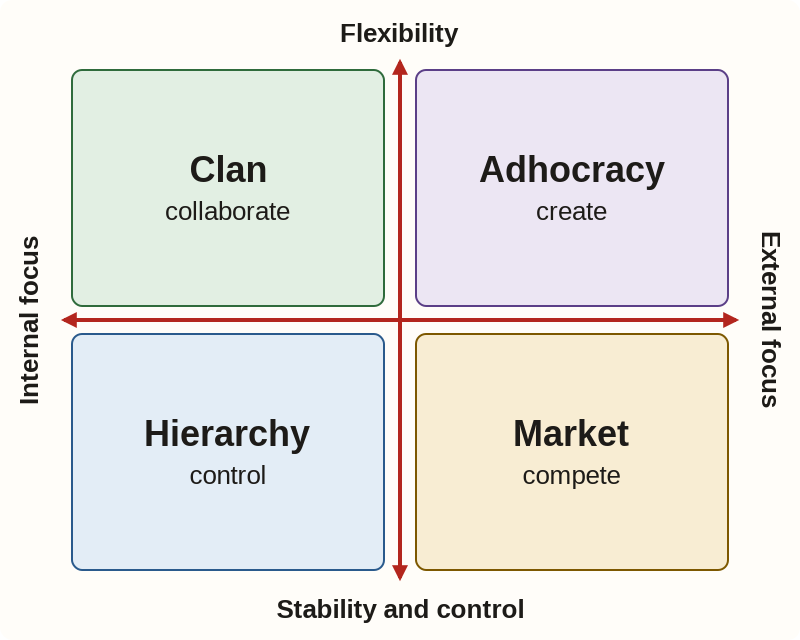
Competing Values Framework
Plots organisations on two tensions, flexibility versus control and internal versus external focus.Read the framework →What has to change besides the org chart?
Now design. The Galbraith Star Model treats organisation design as five policies that must fit each other and the strategy: strategy, structure, processes, rewards and people. If you move to teams organised around customers, you also need processes that let those teams make decisions, rewards that recognise shared results and people with the skills to work that way. Draft the design across all five points, using the diagnosis and culture gap as the brief.
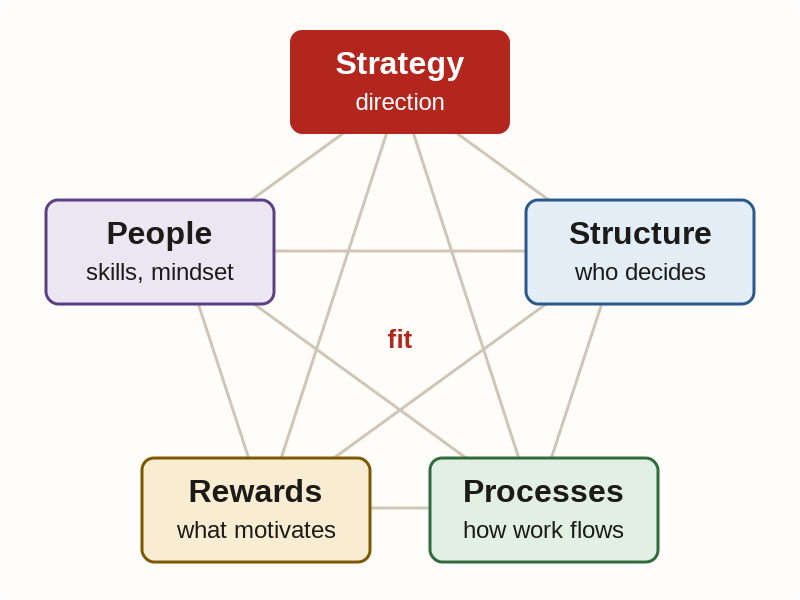
Galbraith Star Model
Treats organisation design as five policies that must fit each other and the strategy.Read the framework →Does the new design hang together?
Before you commit, test the draft for fit. The McKinsey 7S lays out seven elements, from strategy, structure and systems to shared values, skills, style and staff, and asks whether they reinforce one another. Take each pair in turn: does the leadership style suit the new structure, do the systems give the new teams the information they need? Where two elements clash, adjust the design now. It is far cheaper to change a draft than a reorganisation already announced.
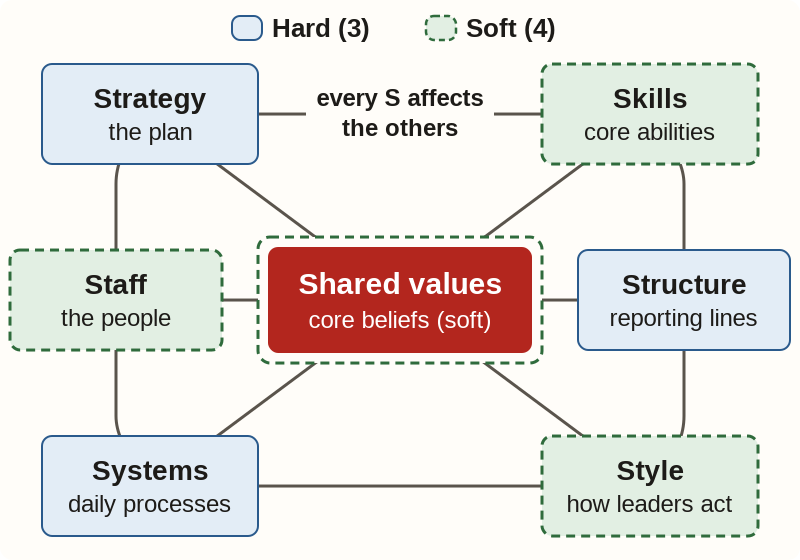
McKinsey 7S
Checks alignment across seven interdependent organisational elements.Read the framework →How do we help people through the move?
A reorganisation changes people's roles, managers and teams, and the design only works if they let go of the old arrangement. Bridges' Transition Model separates the external change from the inner transition: an ending, an uncertain neutral zone and a new beginning. Plan for each. Acknowledge what people are losing, give them clear information and early decisions about their roles during the neutral zone, and mark the new beginning with practical changes, not just an announcement.
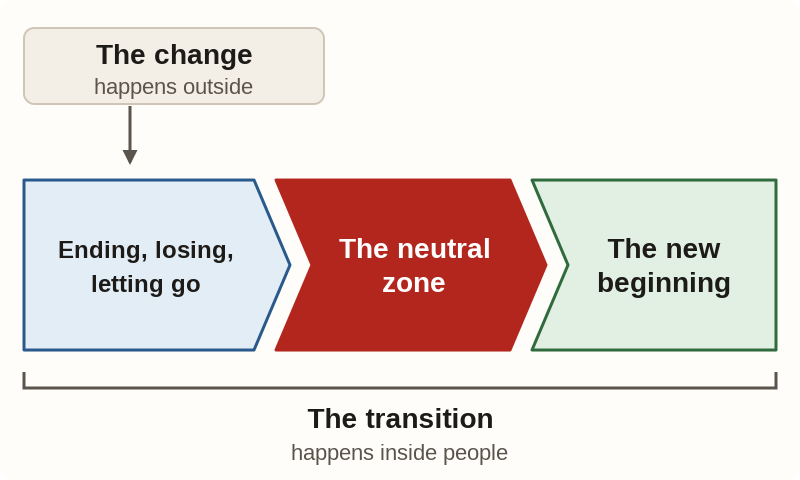
Bridges' Transition Model
Separates the external change from the inner transition people go through to accept it.Read the framework →
Read next
Leading a change programme
You have to move an organisation from the old way of working to a new one. Plan the change and bring people with you.
A team that isn't working
Deadlines slip, meetings go quiet and the same arguments keep coming back. Find out why, then decide what to change first.
Developing your people
You want your team to grow, not just deliver. Adapt how you lead each person, coach well, shape their roles and check it works.