Competing Values Framework
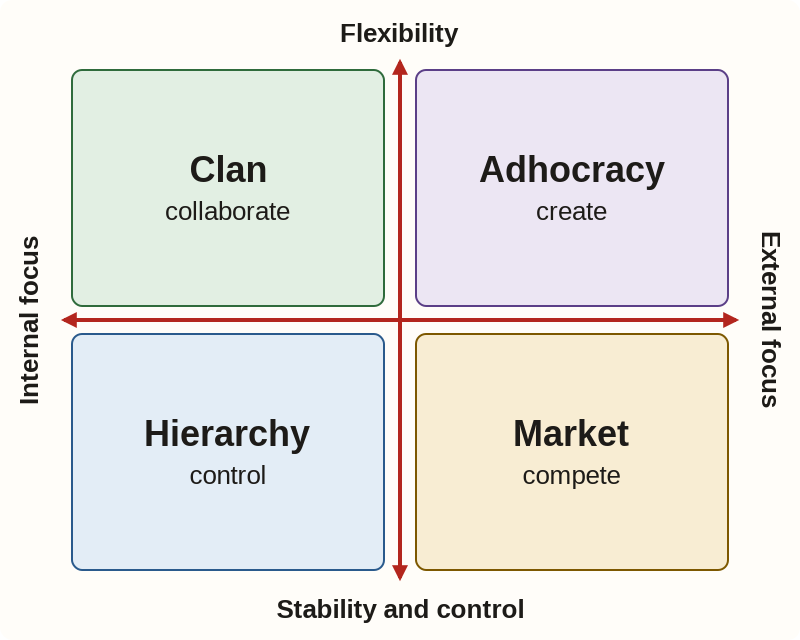
Plots organisations on two tensions, flexibility versus control and internal versus external focus.
Helps with
- describing our current culture
- choosing the culture we want to move towards
- tension between flexibility and control
- mismatch between internal and external focus
Use it when
Profiling a culture and the culture you want to move towards.
The parts
- Flexibility vs stability and control
- Internal vs external focus
- Clan (collaborate)
- Adhocracy (create)
- Market (compete)
- Hierarchy (control)
Watch out
The four types are ideal poles; real organisations mix them, and survey scores can make a messy culture look neatly classified.
Where it comes from
Quinn and Rohrbaugh's 1983 Management Science paper set out the spatial model and its three value dimensions (control-flexibility, internal-external, means-ends); the clan, adhocracy, market and hierarchy culture types were added later by Cameron and Quinn.