SECI Model
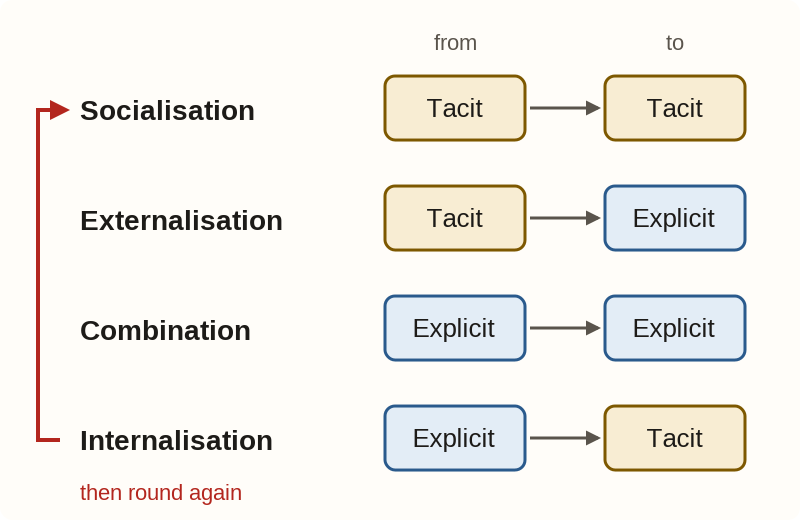
Describes how knowledge is created by converting it between tacit and explicit forms in a spiral.
Helps with
- knowledge leaves when people leave
- know-how stuck in people's heads
- sharing expertise across the company
- capturing tacit knowledge
Use it when
Designing how know-how gets shared and captured across a company.
The parts
- Socialisation (tacit to tacit)
- Externalisation (tacit to explicit)
- Combination (explicit to explicit)
- Internalisation (explicit to tacit)
Watch out
The modes are hard to observe or measure, and critics question whether combination is knowledge creation at all rather than information handling.
Where it comes from
Nonaka first described four patterns of tacit-explicit interaction in 'The Knowledge-Creating Company' (Harvard Business Review, 1991); his 1995 book with Hirotaka Takeuchi made the model widely known.