Scenario
Launching a new product
You have an idea for a new product and want to launch without wasting a year. Go from customer need to a tested first version.
Say your team has a promising idea and a budget for the year. The risk is not that you build badly but that you build something nobody needs as much as you hoped. This guide orders the work so that each step reduces a specific uncertainty: what customers are trying to do, who has that need, whether your offer fits, what the business rests on, what the first version must contain, and how to test it before going big.
What are customers trying to get done?
Start with demand, not features. Jobs to Be Done asks what progress a customer is trying to make in a particular situation, and what they currently hire to do it, including workarounds, spreadsheets or doing nothing. Interview people who recently switched or struggled. The competing alternatives you uncover are your real competition, and the desired outcomes become your test of value. Different schools define jobs differently, so agree a working definition in the team before you start.
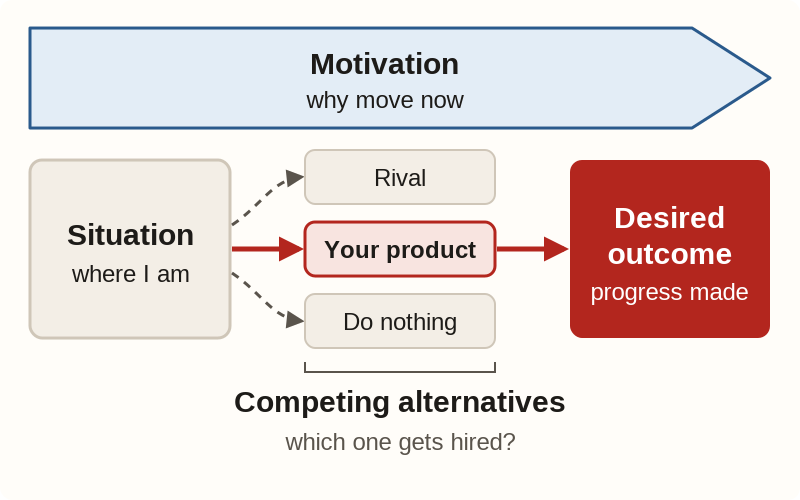
Jobs to Be Done
Views customers as hiring products to make progress in a situation.Read the framework →Who are we designing for?
Jobs tell you what people need; Personas keep the team focused on who has those needs. Turn the interview findings into a small set of archetypes built on observed behaviour and goals, and choose one primary persona for the first release. This gives designers and engineers a shared answer when they disagree about a detail. If you cannot point to research behind a persona, treat it as a guess and go back to the interviews.
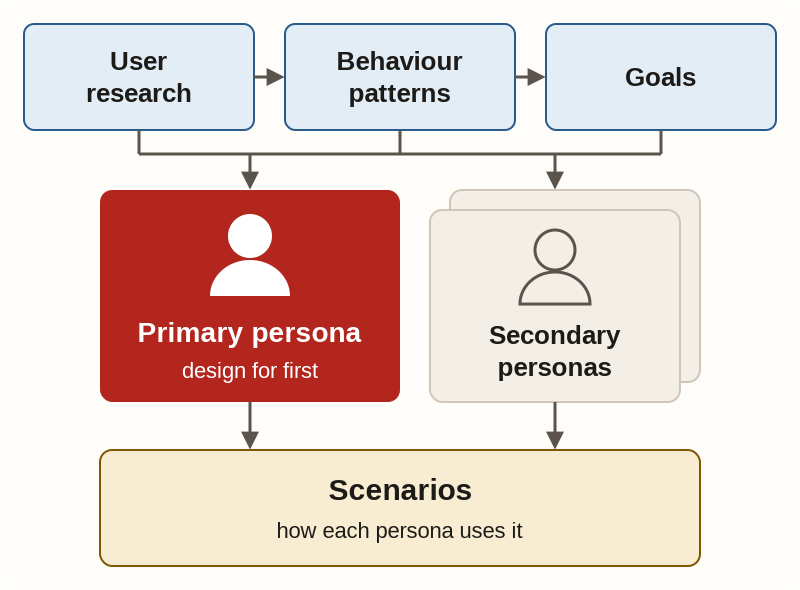
Personas
Sums up research on real users as a few named archetypes whose goals guide design decisions.Read the framework →Does our offer fit their jobs, pains and gains?
Now match your idea to the primary persona. The Value Proposition Canvas puts the customer's jobs, pains and gains on one side and your product, pain relievers and gain creators on the other. Gaps show up quickly: a feature that relieves no pain, or a major pain you ignore. Fill the customer side from your research, not from memory. The pains you address best become the core of your launch message.
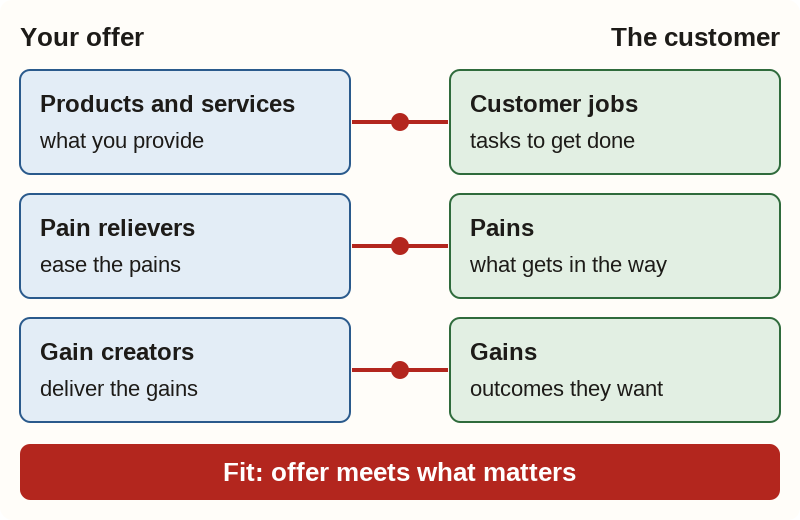
Value Proposition Canvas
Matches what a product offers to a customer segment's jobs, pains and gains.Read the framework →What does the business depend on?
A good fit still needs a workable business. The Lean Canvas captures the problem, customer segments, unique value proposition, solution, channels, revenue, costs, key metrics and any unfair advantage on one page. Its main use here is to expose the riskiest assumptions: perhaps that customers will find you through one channel, or will pay monthly. Rank those assumptions by how much damage they would do if wrong. That ranked list is what your experiments must test.
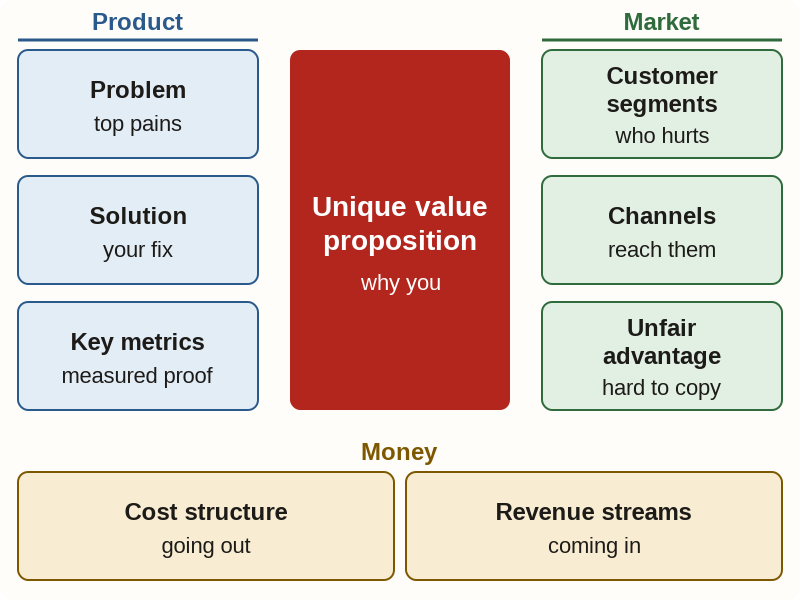
Lean Canvas
Adapts the Business Model Canvas for early-stage start-ups.Read the framework →What must the first version include?
Before building, decide scope. The Kano Model sorts features into basics customers expect, performance features where more is better, delighters that surprise, and features nobody cares about. The first version needs the basics, enough performance to compete, and perhaps one delighter that carries your value proposition. Leave the rest out. Survey your target persona rather than the team, since internal favourites often turn out to be indifferent to buyers.
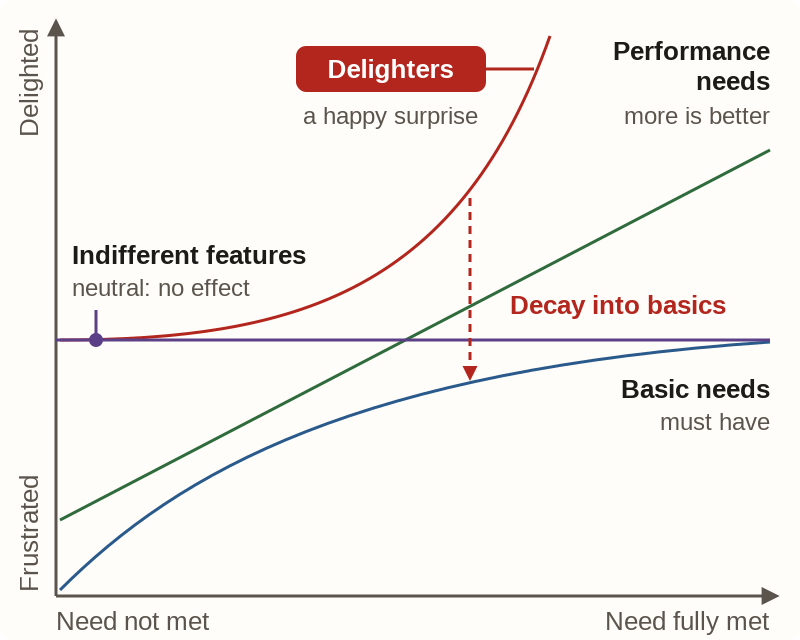
Kano Model
Classifies features by how they affect customer satisfaction.Read the framework →How do we test before going all in?
Lean Startup turns the riskiest assumptions into build-measure-learn cycles. Build the smallest thing that tests the top assumption, measure what customers do, and decide whether to persevere or pivot. Set the success threshold before each test so results cannot be reinterpreted afterwards. This approach suits products where a failed experiment is cheap; in regulated or safety-critical areas, use controlled pilots instead. Each cycle feeds back into the canvas and the feature list.
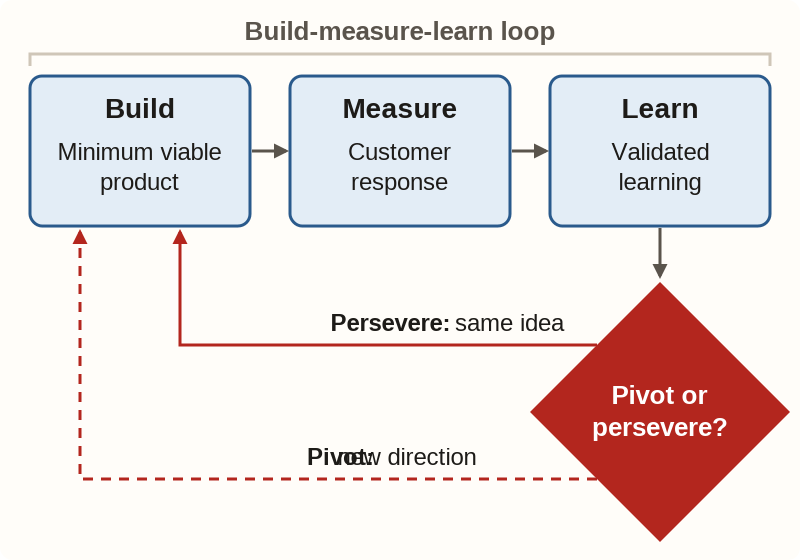
Lean Startup
Reduces uncertainty through rapid build-measure-learn cycles.Read the framework →
Read next
Pricing a product
You need to set or reset a price and want more than a guess. Go from customer value to a price that makes money and holds.
Prioritising a roadmap or backlog
Too many requests, not enough people. Clear the pile, judge what each item is worth, sequence the work and fix the next release.
Managing an innovation portfolio
You have more ideas than money and a core business that wants it all. Balance your innovation bets, plan them and prune them.