Scenario
Negotiating a deal
You need an agreement that works without giving away too much. Choose your approach, know your fallback and find where a deal can land.
Say you are about to renew a contract with your largest supplier, who wants a sizeable price rise. You need them, but they also need you, and you will be working together long after this round. Good negotiation is mostly preparation. These steps take you from deciding how to approach the talks, through working out what each side wants and what you will do if talks fail, to judging where a deal can sit.
How should we approach this negotiation?
Start by choosing a stance. Thomas-Kilmann Conflict Modes sets out five ways to handle a disagreement, from competing to accommodating. A one-off purchase with no future relationship may justify a firmer, more competitive approach. A long-term supplier usually calls for collaborating on the issues that matter and compromising on minor ones. Collaboration takes time, so do not spend it on every point. Decide in advance which issues you will work through together and which you will trade, and agree who on your side has authority to settle each one. Take that into your preparation.
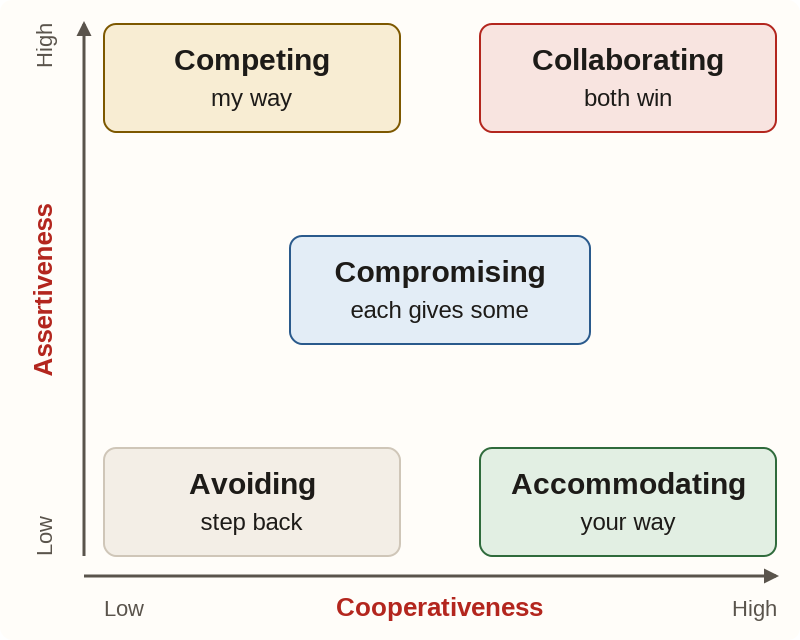
Thomas-Kilmann Conflict Modes
Sorts ways of handling conflict by assertiveness and cooperativeness into five modes.Read the framework →What do both sides need, and what is our fallback?
Principled Negotiation (BATNA) moves you away from trading positions. Behind the supplier's price rise may be rising costs, a wish for volume certainty or cash-flow pressure. Behind your resistance may be a budget limit or concern about service. Listing interests on both sides opens options such as a longer term, volume commitments or staged increases. Agree objective standards, such as market rates or cost indices, to anchor the discussion. Above all, know your BATNA: what you will do if there is no deal. It sets the limit you take into the next step.
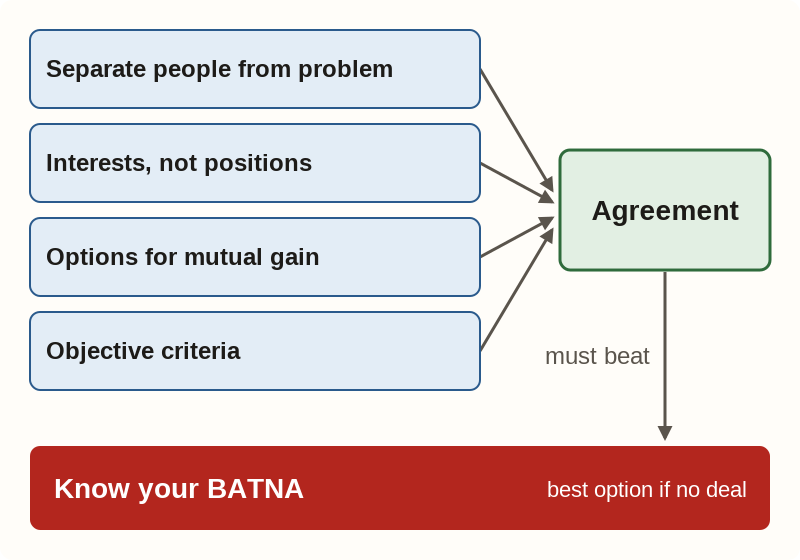
Principled Negotiation (BATNA)
Negotiates on interests and fair standards rather than haggling over positions.Read the framework →Is there a deal to be had, and where?
With your walk-away point clear, estimate the ZOPA (Zone of Possible Agreement): the overlap, if there is one, between the highest price you would pay and the lowest price the supplier would take. Their alternatives, such as other customers or spare capacity, hint at where their walk-away might be. If the ranges do not overlap, no amount of skill will produce a sensible deal, and walking away is the right result. Treat the zone as a working estimate, and revise it as you learn more in the room. Where it overlaps, open near the edge of the zone that favours you, but not so far out that you lose credibility.
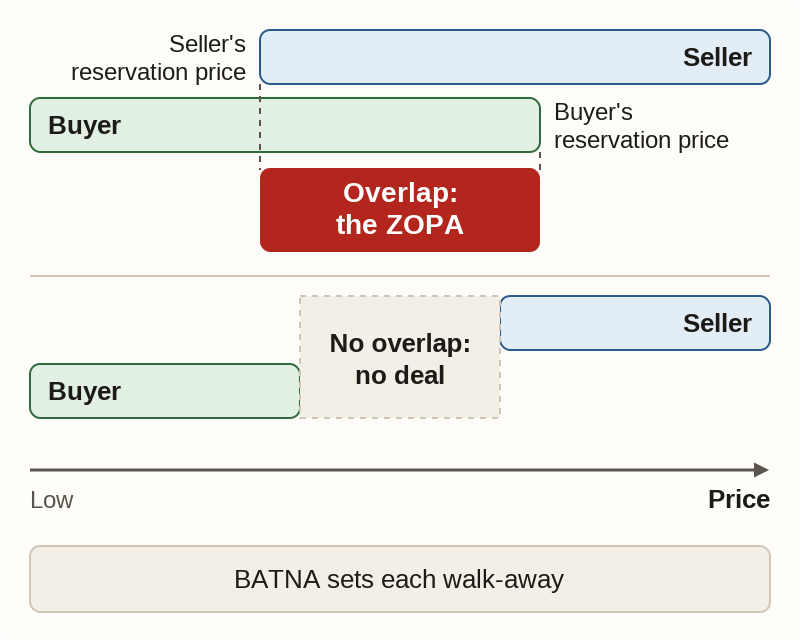
ZOPA (Zone of Possible Agreement)
Shows the range where both sides' walk-away points overlap, so a deal is possible.Read the framework →
Read next
Pricing a product
You need to set or reset a price and want more than a guess. Go from customer value to a price that makes money and holds.
Making a hard decision
The options are unclear, the stakes are high and people disagree. Frame the decision, settle who decides and test the choice.
Writing a recommendation
The analysis is done and someone senior needs a decision. Structure the problem and write a recommendation they can act on.