Economic Order Quantity
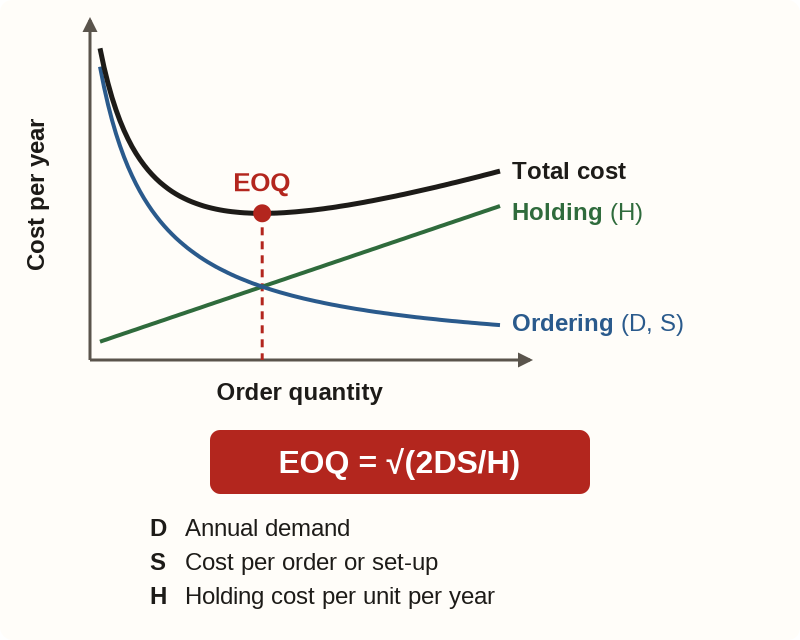
Calculates the order size that minimises the combined cost of ordering and holding stock.
Helps with
- how much stock to order at a time
- working out a reorder quantity
- balancing ordering cost against holding cost
- ordering too much or too often
Use it when
Setting a reorder quantity for an item with steady demand.
The parts
- Annual demand (D)
- Cost per order or set-up (S)
- Holding cost per unit per year (H)
- EOQ = √(2DS/H)
Watch out
It assumes steady demand, fixed costs and no quantity discounts or capacity limits, which rarely all hold.
Where it comes from
Harris's paper was long forgotten and the result is often called the Wilson formula; Donald Erlenkotter traced it back to Harris in 1989-1990.